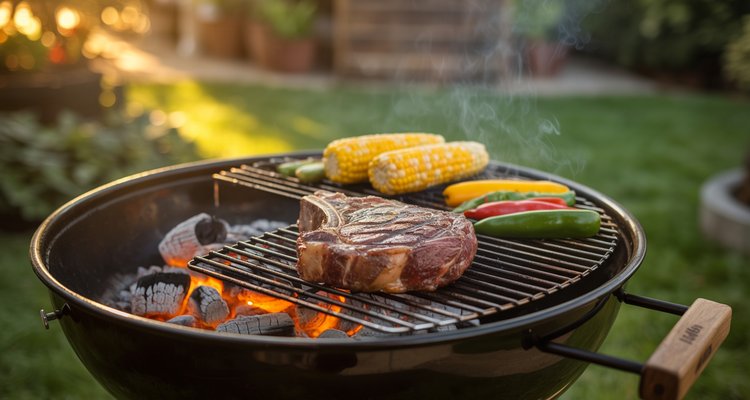
Your steak hits the grill looking perfect – then you lift the lid ten minutes later to find the outside charred black while the center is still raw. That’s what happens when everything cooks over a single blast of direct heat with nowhere to go. Two zone grilling solves that problem by splitting your grill into a hot searing side and a cool finishing side, giving you full control over every cook.
Helpful Gear for This Guide
What Is Two-Zone Grilling?
Two-zone grilling means dividing your grill into two distinct heat areas: a direct heat zone where food sits directly over the flame or coals, and an indirect heat zone where food cooks away from the heat source. The result is a grill that functions like both a stovetop and an oven at the same time.
On the direct side, intense heat sears surfaces fast, creating the caramelized crust and grill marks that make grilled food taste so good. On the indirect side, hot circulating air cooks food through slowly and evenly without any risk of burning the exterior before the interior is done.
This single setup change transforms your grill from a one-trick direct-heat machine into a versatile outdoor cooking tool capable of handling everything from thin chicken wings to a whole brisket.
Direct Heat vs. Indirect Heat: Key Differences
The Direct Heat Zone (Hot Side)
The direct heat zone sits directly above your heat source – charcoal or a lit gas burner. Temperatures on this side typically run between 450°F and 600°F at grate level. Food placed here cooks quickly through conduction: the grate and radiant heat from below transfer energy directly into the food’s surface.
This is where the Maillard reaction happens – the chemical process that creates the golden-brown crust, char marks, and deep savory flavor that everyone associates with grilled food. Direct heat is the right tool for anything thin enough to cook through before the outside burns: burgers, steaks under an inch thick, fish fillets, shrimp, and sliced vegetables.
The Indirect Heat Zone (Cool Side)
The indirect heat zone has no heat source beneath it. Instead, the hot air circulating inside the closed grill does the cooking – the same convection principle as an oven. Temperatures in this zone typically range from 225°F to 350°F depending on how hot your direct side is running.
Food in the indirect zone cooks slowly and evenly from all sides with no risk of flare-ups or scorching. This makes it ideal for large cuts that need time for the interior to reach safe temperatures, for bone-in pieces where the bone slows cooking, and for any food that needs to finish gently after a hard sear.
| Feature | Direct Heat (Hot Zone) | Indirect Heat (Cool Zone) |
|---|---|---|
| Temperature | 450-600°F | 225-350°F |
| Heat Source | Directly below food | None below food |
| Cooking Method | Conduction + radiation | Convection (like oven) |
| Best Foods | Burgers, thin steaks, shrimp, veggies | Roasts, ribs, whole chicken, thick cuts |
| Lid Position | Open or closed | Always closed |
| Technique | Searing, charring, quick cooking | Baking, roasting, finishing, gentle cooking |
How to Set Up a Two-Zone Fire on a Charcoal Grill
Setting up two zones on a charcoal grill like a Weber Kettle is simple: arrange the lit coals on one side of the charcoal grate. That side becomes your direct heat zone, and the other side becomes your indirect heat zone.
- Light Charcoal: Fill a charcoal chimney starter about two-thirds full with briquettes or lump charcoal. Light the chimney and wait 15-20 minutes until the top coals are covered in a thin layer of gray ash.
- Arrange Coals: Pour the lit coals onto one side of the charcoal grate, banking them so they cover about half of the grate area. Leave the other half empty.
- Position Grates: Place the main cooking grate over the coals. The side of the grate directly over the lit coals is your direct zone.
- Preheat: Close the grill lid with the top vent positioned directly over the cool side of the grate. This helps draw hot air and smoke across the indirect zone. Open both top and bottom vents fully and let the grill preheat for 10-15 minutes.
For a circular kettle grill, the most common setup is the simple two-zone fire. But for rectangular or larger grills, other arrangements offer more flexibility:
- Three-Zone Fire: Bank coals on both the left and right sides of the grill, leaving the center empty as a large indirect zone. This is ideal for roasting whole chickens or large cuts of meat, as it provides even heat from both sides.
- Vortex Setup: Use a Vortex accessory or a foil-lined bowl to concentrate coals in the center of the grill. This creates an extremely hot central direct zone and a cooler indirect perimeter, perfect for crispy chicken wings and reverse searing.
How to Set Up a Two-Zone Fire on a Gas Grill
On a gas grill, setting up two zones is as simple as lighting some burners and leaving others off.
- Ignite Burners: On a grill with three or more burners, light the burners on one side (e.g., the left and center burners) and set them to high. Leave the burner(s) on the other side unlit.
- Preheat: Close the grill lid and let the grill preheat for 10-15 minutes until the lit side reaches searing temperature (450-550°F).
- Adjust Heat: Once preheated, adjust the lit burners to your target direct-side temperature. The unlit side will settle into a stable indirect zone temperature, typically 100-150°F cooler than the direct side.
For a two-burner gas grill, the setup is even simpler: light one burner and leave the other off. The space above the unlit burner becomes your indirect zone. While smaller, it’s still large enough to finish steaks or cook chicken pieces away from direct flame.
Common Two-Zone Grilling Techniques
Once your two zones are established, you can use them in combination to cook virtually anything. The most common technique is the sear-and-finish, but the reverse sear is essential for thick cuts.
The Sear-and-Finish Method
This is the workhorse technique for most grilled foods:
- Sear on Direct Heat: Start by searing your food on the hot direct side of the grill. For steaks, this means 2-3 minutes per side. For chicken pieces, 5-7 minutes per side until the skin is golden brown and crispy.
- Move to Indirect Heat: Once the exterior has the color and char you want, move the food to the cool indirect side of the grill.
- Finish with Lid Closed: Close the lid and let the food finish cooking in the oven-like convection heat of the indirect zone. This is where you use your instant-read thermometer to check for doneness. Pull the food off the grill when it’s 5-10 degrees below your target finishing temperature to account for carryover cooking.
The Reverse Sear Method
For thick-cut steaks (1.5 inches or more), the reverse sear produces a more evenly cooked interior than the traditional sear-first approach:
- Start on Indirect Heat: Place your seasoned steak on the cool indirect side of the grill and close the lid. Let it cook gently until the internal temperature is about 15-20 degrees below your target (e.g., 110-115°F for a medium-rare finish of 130°F).
- Sear on Direct Heat: Move the steak to the hot direct side and sear for 60-90 seconds per side, just long enough to develop a deep brown crust.
- Rest and Serve: Remove the steak from the grill and let it rest for 5-10 minutes before slicing. Because the interior came up to temperature slowly, it needs less resting time than a traditionally seared steak.
Frequently Asked Questions
What is two-zone grilling?
Two-zone grilling is a method of dividing your grill into two heat areas: one side with direct heat (coals or lit burners beneath the food) and one side with indirect heat (no heat source beneath the food). The direct zone is for searing and fast cooking; the indirect zone is for slow, even finishing and temperature control.
How do I set up two zones on a kettle grill?
On a standard 22-inch Weber kettle or similar round charcoal grill, pour all your lit coals to one side of the charcoal grate. The side with coals is your direct heat zone; the other side is your indirect zone. Replace the cooking grate, close the lid, and preheat for 10-15 minutes before cooking.
What temperature should the direct heat zone be?
For searing steaks and burgers, aim for 450-550°F on the direct zone. For chicken pieces and fish, 375-450°F works better – hot enough to brown without burning. You can control charcoal grill heat by adjusting vent openings; gas grills adjust instantly with the burner knobs.
What temperature should the indirect heat zone be?
The indirect zone temperature depends on what you’re cooking. For most whole chicken and bone-in pieces, 325-350°F in the indirect zone produces great results. For low-and-slow cooks like ribs and pork shoulder, keep the indirect side at 225-250°F. The indirect zone temperature is always lower than the direct side – typically 100-200°F lower.
What is the reverse sear method?
The reverse sear is a two-zone technique where you cook a thick steak slowly on the indirect zone first, bringing the interior close to your target temperature, then finish it with a fast sear on the direct zone to develop a crust. It produces more even doneness from edge to edge than the traditional sear-first method, and works best on steaks 1.5 inches thick or more.
Can I use two-zone grilling on a small grill?
Yes, though the size of each zone is smaller. On a compact 18-inch kettle, bank coals to one-third of the grate and keep two-thirds as indirect. On a 2-burner gas grill, light one burner and leave the other off. The principle works on any grill with at least two burners or enough width to separate coals from open grate space.
How do I prevent flare-ups using two-zone grilling?
The indirect zone acts as your escape route during flare-ups. When fat drips cause flames to shoot up on the direct side, immediately slide the food over to the indirect zone and close the lid. The lack of oxygen and direct heat will cause the flare-up to die out in seconds. Do not spray water on a charcoal grill – it scatters ash onto your food and can cause steam burns.
When should I move food from direct to indirect heat?
Move food to the indirect zone when the exterior has the color and crust you want but the interior isn’t done yet. For steaks, this typically means both sides are seared to a deep brown. For chicken pieces, after 5-7 minutes per side on direct heat. Watch the color and use a thermometer to confirm where you are on the internal temperature.
What is the 3-3-3 rule for grilling?
The 3-3-3 rule is an informal guideline for cooking a 1-inch burger patty: 3 minutes on direct heat, flip, 3 more minutes, then 3 minutes of rest. It’s a starting point, not a universal rule – actual timing varies by grill temperature, patty thickness, and desired doneness. Always verify with a thermometer: 160°F for a fully cooked ground beef patty.
How long can I keep food in the indirect zone?
As long as needed. The indirect zone doesn’t overcook food the way direct heat does – it just keeps it warm and cooking gently. Ribs can sit in the indirect zone for 3-4 hours. A whole chicken takes 60-90 minutes. The lid-closed indirect zone is forgiving. Just keep an eye on your coal level (charcoal) or propane level (gas) for very long cooks.
Do I need a thermometer for two-zone grilling?
Yes. An instant-read thermometer is the single most useful piece of equipment for two zone grilling. It removes all the guesswork from knowing when to move food between zones, when to pull food off the grill, and whether a thick cut is safe to eat. It doesn’t have to be expensive – a reliable digital thermometer costs under $20 and lasts for years.
Can two-zone grilling be used for smoking?
Absolutely. Two-zone grilling is the foundation of low-and-slow smoking on a kettle or gas grill. On a charcoal grill, bank the coals and add 2-3 chunks of smoking wood (hickory, apple, cherry) directly on the lit coals. Place your meat on the indirect side and close the lid with the top vent positioned over the food to draw smoke across it. Keep the temperature between 225°F and 275°F by adjusting the bottom vent.
Putting It All Together
Two zone grilling isn’t a complicated technique – it’s a simple rearrangement of how you use heat that unlocks a dramatically wider range of what you can cook on any grill. Once you’ve set up your first two-zone fire, the instinct of “sear here, finish there” becomes second nature fast.
Start with something forgiving: bone-in chicken thighs on a charcoal kettle. Sear them 5 minutes per side on the direct zone, then finish on the indirect side with the lid closed until they hit 165°F. By the time they come off the grill, you’ll understand exactly why two zone grilling is the technique every serious griller comes back to – every single cook.