
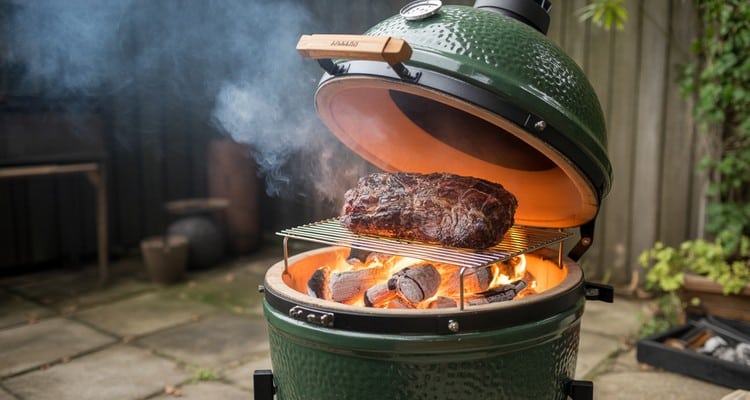
You bought the Big Green Egg for precision cooking. Then you fired it up, set the dome gauge to 250°F, and pulled out a brisket that was running well below your target temperature. Sound familiar? The built-in dome thermometer on every BGE reads 50–75°F hotter than grate level — where your food actually cooks. It’s not a defect. It’s physics: hot air rises and collects at the dome, far above your cooking surface.
The right big green egg thermometer fixes this immediately. In this guide, we cover three types of thermometers BGE owners actually rely on: dome replacements that give you an accurate ambient baseline, wireless probes that monitor grate-level and internal meat temperatures in real time, and wired leave-in options that eliminate the ceramic-wall signal problem entirely. If you cook on a Kamado Joe, Primo, or another kamado-style cooker, everything here applies to you too.
Quick Roundup List
- Best Overall: Typhur Sync Gold
- Best Truly Wireless Probe: MEATER Pro
- Best Budget Wireless: ThermoPro TempSpike Plus
- Best for Rock-Solid Reliability: ThermoWorks DOT
- Best Dome Replacement: Tel-Tru BQ325R
Why the Built-In BGE Thermometer Isn’t Enough
Every Big Green Egg ships with a bi-metal analog temperature gauge mounted in the dome lid. It measures what’s happening near the top of the grill — not at grate level where your brisket, ribs, or chicken actually sits.
The differential is real and consistent. When your BGE dome thermometer reads 350°F, your cooking surface is typically running 275–300°F. Set the dome to 700°F for pizza? The grate is probably closer to 625°F. This matters because every cooking temp in a recipe, every pit master tip, and every USDA food safety guideline refers to the heat at the food — not at the dome.
The dome gauge isn’t wrong about what it measures. It’s just measuring the wrong thing. Even an expensive aftermarket analog gauge mounted in the dome has the same limitation — it still reads dome-level heat. The only way to know your true grate-level reading is to put a probe down at grate level. That’s exactly what the thermometers in this guide do.
What to Look For in a Big Green Egg Thermometer
Dome Thermometer Replacements vs. Grate-Level Monitoring
These are two separate jobs, and serious BGE owners use both. A dome thermometer replacement (like the Tel-Tru BQ325R) gives you a quick visual reference for general ambient heat without looking at a screen. A grate-level probe — wireless or wired — gives you precise, real-time data at the cooking surface. For a long brisket smoke, you want both: the dome gauge for quick visual checks, and a wireless probe clipped to the grate or inserted in the meat for accuracy.
Temperature Range — Kamado Grills Run Hot
The BGE’s ceramic thermal mass makes it exceptional at holding heat at both extremes. For low-and-slow work, you’re typically running 225–275°F. Standard grilling sits at 350–450°F. High-heat searing and pizza cooks push 600–700°F and beyond. Any big green egg thermometer you choose needs to be rated for the full range of your grill. The dome replacement should handle 750°F minimum. Ambient sensors on wireless probes should reach 900°F or higher if you regularly grill pizza or sear steaks at full throttle.
Signal Penetration Through Ceramic Walls
This is the BGE-specific challenge that no generic thermometer buyer’s guide mentions. The Big Green Egg’s thick ceramic walls are a significant obstacle for Bluetooth signals. Standard Bluetooth thermometers can lose connection when the lid closes and the probe is deep in the grill — especially if you’re monitoring from inside the house. The solution is one of three approaches: use a thermometer with Sub-1 GHz technology (10x stronger than standard Bluetooth, designed to penetrate dense materials), use a WiFi-enabled system that routes through your home network, or use a wired probe threaded through the BGE’s 3/8″ side port so there’s no signal to lose.
Wireless vs. Wired for Long Smokes
Wireless thermometers offer the freedom to monitor a 12-hour brisket from your couch without stepping outside. WiFi-enabled wireless systems extend that to anywhere with cell service. Wired options — like the ThermoWorks DOT — require you to thread a probe cable through the BGE’s side port or vent gap, which limits placement flexibility but eliminates every connectivity concern. For long smokes where you need total confidence, wired wins on reliability. For everyday flexibility, wireless with good ceramic-wall penetration wins on convenience.
Accuracy and Response Time
For leave-in monitoring on a long smoke, even ±2°F accuracy is more than adequate — you’re watching heat trends over hours, not split-second readings. Premium wireless probes like the Typhur Sync Gold hit ±0.5°F with triple-calibration during production. The ThermoWorks DOT is rated ±1.8°F, which is still reliable for overnight smoking. Where accuracy matters most is on high-heat grills: a 10°F error at 500°F grate heat can mean the difference between a perfect steak sear and an overcooked one.
The Best Big Green Egg Thermometers for 2026
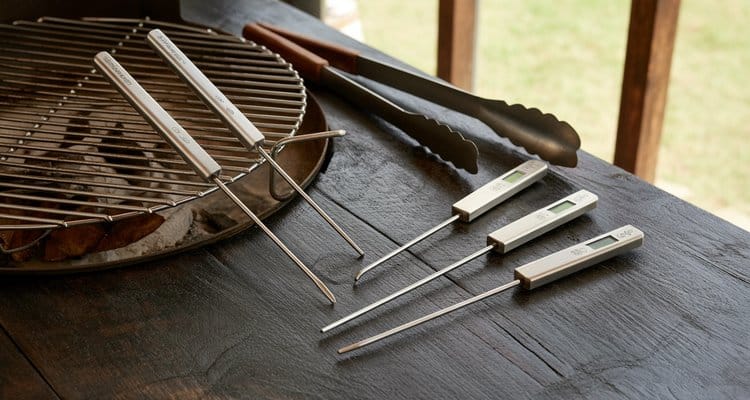
We evaluated these thermometers specifically for kamado performance: ceramic signal penetration, high-heat probe ratings, dome replacement compatibility, and high performance on both long smokes and high-heat grilling. Here are the five best big green egg thermometers that earned a spot in this guide.
Typhur Sync Gold – Best Overall

The Typhur Sync Gold was built for exactly the problem of wireless thermometers dropping signal through the BGE’s ceramic walls. It’s the world’s first wireless meat thermometer powered by Sub-1 GHz technology — a signal 10x stronger than standard Bluetooth that was specifically designed to penetrate walls, smokers, and kamado grills. Pair that with WiFi connectivity for unlimited range, and you can monitor a 12-hour brisket from anywhere: your couch, another floor of the house, or across town. This is the most capable big green egg thermometer on this list for serious cooks who want complete confidence on long smokes.
Two slim stainless steel probes, six sensors each, let you monitor two proteins simultaneously — or run one probe at grate level for ambient heat and one in the meat. The ±0.5°F accuracy is triple-calibrated during production, and the 932°F max probe rating handles any heat the BGE can generate. The standalone base displays live readings without your phone, which is useful when you’re out at the grill. For BGE owners who want reliable results on long smokes and high-heat grilling alike, the Typhur Sync Gold delivers both without compromise.
Highlights
- Sub-1 GHz signal (10x stronger than Bluetooth) — penetrates kamado ceramic walls reliably
- WiFi + Sub-1G connectivity for unlimited range monitoring from anywhere
- 2 slim probes with 6 sensors each — monitor 2 proteins or meat + ambient grate temp
- ±0.5°F accuracy, triple-calibrated during production
- 932°F max probe temperature — handles BGE pizza and searing cooks
- IPX8 waterproof, standalone base display
Specifications
- Connectivity: Sub-1 GHz + WiFi (unlimited range)
- Probes: 2 slim stainless steel probes, 6 sensors each
- Accuracy: ±0.5°F
- Max Probe Temp: 932°F
Customer Reviews
- “Significantly better than the Meater I was using with only Bluetooth that kept losing connection. The WiFi is as advertised — game changer when your smoker is on a roof deck and your kitchen is 3 levels down.”
- “After weeks of use, I can confidently say it’s the best wireless meat thermometer on the market. The connection has never dropped, never lagged, and never desynced.”
- “Works great through the grill with the lid closed. Very stable connection.”
MEATER Pro – Best Truly Wireless Probe

The MEATER Pro’s defining feature is its complete lack of wires — nothing to thread through a port, nothing to route through a vent. You insert the stainless steel probe into your meat, the charging case sits outside the grill, and the app monitors everything via Bluetooth Coded PHY long range. For Big Green Egg owners who want zero-cable simplicity and full wireless monitoring from their phone, this is the one to reach for.
The 1000°F ambient heat resistance is the highest on this list — it handles anything the BGE produces, including high-heat pizza cooks that push 700°F dome temperatures. Five internal sensors measure temperature at multiple points inside the probe, finding the coldest internal reading so you don’t get misled by a probe tip that landed near a hot pocket. The guided cook system estimates your rest time, so you’re not cutting into a brisket too early. With over 4,600 Amazon reviews, it’s the most proven wireless probe in this guide. For a deeper look at how MEATER compares to other Bluetooth meat thermometers, we cover the full category in our dedicated guide.
One note: MEATER Pro uses Bluetooth only (no WiFi). Through dense kamado ceramic, some users report signal drops when the base is positioned far from the grill. Keep the charging case within 10–15 feet and in line of sight with the grill for the most reliable connection.
Highlights
- 100% wireless — no cables to route through the BGE side port or vent gap
- 1000°F ambient heat resistance — highest rated for high-heat BGE cooks
- 5-sensor array measures at multiple points to find the true cold center
- Guided cook system with rest time estimation in app
- Dishwasher safe, fast-charging (15 min = 12 hrs battery life)
- 4,643 reviews — most proven wireless probe in this guide
Specifications
- Connectivity: Bluetooth Coded PHY (long range)
- Probes: 1 probe, 5 internal sensors
- Max Ambient Temp: 1000°F
- App: iOS, Android, Apple Watch, Alexa
Customer Reviews
- “What sets MEATER apart and worth the extra money is its higher heat rating, its thin design, its battery life, and its app. It really makes grilling a simple process.”
- “It discovered the probe built into my smoker averaged +6 degrees variance from the Meater probes — my brisket would have been severely undercooked had I relied on the built-in gauge.”
- “Leaps and bounds over the competition, worth any small premium for serious BBQ enthusiasts.”
ThermoPro TempSpike Plus – Best Budget Wireless

The ThermoPro TempSpike Plus delivers outstanding per-probe value with two probes included. The color-coded probes let you monitor two cuts simultaneously — one probe in your brisket, one at grate level for ambient temperature tracking — which is the ideal setup for kamado cooking. Bluetooth 5.2 delivers a 600-foot rated range, and the LCD booster displays live meat and ambient temperatures directly so you can check the grill without pulling out your phone.
The ceramic-tipped probe is rated to 1050°F, which covers every cooking temperature the BGE reaches. The probes come pre-paired and ready to use out of the box — no WiFi setup, no account creation, no app required to get started. For BGE owners who want reliable wireless temperature monitoring without the premium price tag, this is the pick. One practical note: Bluetooth range through kamado ceramic walls is real-world closer to 15–20 feet from probe to booster, so position the LCD booster outside near the grill rather than inside the house.
Highlights
- 2 color-coded probes for simultaneous meat and grate-level temperature monitoring
- LCD booster displays live temps without needing the app open
- 1050°F ceramic-tipped probe — rated for all BGE cooking temperatures including searing
- Pre-paired out of box, no WiFi or account required
- IP67 waterproof — rinse under running water for cleanup
- Excellent per-probe value
Specifications
- Connectivity: Bluetooth 5.2, 600ft rated range
- Probes: 2 color-coded probes
- Max Probe Temp: 1050°F (ceramic tip)
- Waterproof: IP67
Customer Reviews
- “Signal will actually go through the lid or the wall of your grill — both criteria were well satisfied.”
- “Simple with no app is probably the best part. I can also use this in the oven for everyday cooking.”
- “Two probes let me place them in different parts of the meat — great when a cut is different thicknesses.”
ThermoWorks DOT – Best for Rock-Solid Reliability

If ceramic walls kill your wireless signal — or if you simply never want to think about Bluetooth connectivity during a session — the ThermoWorks DOT solves the problem permanently. Thread the wired probe through the BGE’s 3/8″ side port, set your target temperature with two buttons, and the alarm sounds when the meat hits your number. No app, no WiFi, no Bluetooth. Just a direct reading from a ThermoWorks Pro-Series probe to a display sitting on your patio table.
It’s the highest-rated thermometer in this guide at 4.6 stars, and America’s Test Kitchen recommends it as their number-one leave-in thermometer. The 5,000-hour battery life (two AAA batteries) means you’ll never face a mid-smoke dead battery. You can swap Pro-Series probes mid-session without turning the unit off — pull out the meat probe and plug in an air probe to check grate temperature, then switch back. The DOT works with every Pro-Series probe ThermoWorks makes, giving it flexibility a single-purpose wireless probe can’t match.
One consideration: the wired probe’s cable needs to route into the BGE. Most BGE owners thread it through the 3/8″ side port, or run it through the daisy wheel vent with minimal gap. If you’re not sure how to set up wired probes in a kamado, see our complete thermometer guide for setup tips across different grill types.
Highlights
- Highest-rated thermometer in this guide: 4.6 stars
- America’s Test Kitchen #1 recommended leave-in thermometer
- Wired probe = zero connectivity issues through ceramic — always connected
- 5,000-hour battery life on 2x AAA — outlasts any wireless battery system
- Swappable ThermoWorks Pro-Series probes — meat probe, air probe, high-temp probe all compatible
- Magnetic back + kickstand, IP65 splash-resistant, large backlit display
Specifications
- Connectivity: Wired (Pro-Series probe, swappable mid-session)
- Accuracy: ±1.8°F
- Temperature Range: -58°F to 572°F
- Battery Life: 5,000 hours (2x AAA)
Customer Reviews
- “No complicated setup or unnecessary features. You turn it on, it gives you a precise reading, and you can trust the result. That level of simplicity paired with real accuracy is exactly what I want.”
- “The cord has no trouble being pinched between the oven and door with the DOT sitting on the counter. The timer is loud enough to be heard from another room.”
- “After years of using it, it’s improved my sourdough and ensured my prime rib was medium rare. Perfect for the price.”
Tel-Tru BQ325R – Best Dome Replacement

Tel-Tru has manufactured precision thermometers in Rochester, New York since 1937. The Tel-Tru BQ325R is their kamado-specific dome replacement — designed to drop into the Big Green Egg, Primo, Komodo, Grill Dome, and other kamado grills with a stem dimensioned for the dome port. The stock BGE thermometer is a convenience gauge. The BQ325R is an industrial instrument, and it gives you reliable ambient heat data every time you glance at the dome.
The 3-inch dial with color-coded red and black zones is readable from across your patio without squinting. The 150–750°F range covers every BGE cooking mode: low-and-slow smoking at 225°F, general grilling at 400°F, and high-heat pizza and searing at 700°F+. The R suffix in the model name is important — it means this unit is calibratable. If the needle drifts over time, you can control the correction with a calibration nut behind the face. The base BQ225 model cannot be adjusted. It’s the most straightforward upgrade a Big Green Egg owner can make in under five minutes with a wrench, and it gives you reliable dome-level heat control from day one.
Highlights
- Specifically designed for Big Green Egg, Primo, Komodo, Grill Dome, and other kamado cookers
- Large 3″ dial with color-coded zones — readable at a distance from your patio
- 150–750°F range covers all BGE cooking modes including high-heat pizza and searing
- Calibratable (R suffix) — adjustable with the calibration nut if readings drift
- Made in USA since 1937 — industrial-grade accuracy, not consumer electronics
- Drop-in installation: remove the old gauge with a wrench, thread in the BQ325R
Specifications
- Dial Size: 3 inches
- Stem: 3 inches (kamado-specific fit)
- Temperature Range: 150–750°F
- Mount: Kamado dome-specific, drop-in replacement
Customer Reviews
- “Buy once, cry once applies. These last and they are accurate. I’ve spent far more replacing cheaper ones every year.”
- “I can see this temp at a distance, no need to be right on top of it. Love this large dial. Great upgrade for my BGE.”
- “Finally, an accurate thermometer. The original was incredibly inaccurate and I needed to replace it for proper smoking.”
Big Green Egg Temperature Tips
- Use two thermometers, not one. A dome gauge gives you general ambient heat at a glance. A wireless or wired probe at grate level gives you precise cooking data. They measure different things. The dome gauge isn’t wrong — it’s just measuring 50–75°F above where you’re grilling. Run both for accurate readings on every smoke or grill session.
- Account for the dome-to-grate offset on every smoke. Until you’ve measured your specific BGE’s offset, assume grate heat runs approximately 50°F below dome readings during low-and-slow cooking. The offset shrinks at high heat. Calibrate your understanding of your Big Green Egg over 3–4 monitored sessions with a probe at grate level.
- Thread probe cables through the BGE’s 3/8″ side port. The BGE has a threaded side port on the dome designed for stainless steel probe cables. Thread your wired probe or wireless probe cable through this port to keep the lid fully sealed. A sealed lid means stable heat control and accurate cooking — even a small gap at the cable can cause swings.
- Let the BGE stabilize before trusting your thermometer reading. The BGE’s ceramic thermal mass is its greatest cooking advantage, but it takes time to reach equilibrium. Let the grill sit at your target heat for 15–20 minutes before adding food and trusting your grate-level reading. Readings during heat-up are often misleading. Precise heat management starts with a stable grill.
- High-heat grilling: let the ceramic fully saturate. For pizza at 700°F or searing at 600°F, let the BGE run at target heat for 30 minutes before grilling. The ceramic walls need to reach your target, not just the air inside the grill. Your big green egg thermometer will show a stable reading once the ceramic is fully saturated and you have real temperature control.
- Calibrate your dome thermometer annually. Submerge the probe stem in boiling water — 212°F at sea level, adjusted for altitude. If the needle doesn’t match, use the calibration nut on the back of the Tel-Tru BQ325R to control the adjustment. This takes two minutes and keeps your dome gauge accurate for years. The base BQ225 model cannot be calibrated, which is one reason to choose the BQ325R for your Big Green Egg.
Frequently Asked Questions
What temperature does a Big Green Egg run at?
The BGE can hold heat from around 200°F (for cold smoking with indirect setups) to over 750°F for direct high-heat searing and pizza grilling. The most common operating ranges are 225–275°F for low-and-slow smoking, 350–450°F for general grilling, and 600–700°F for pizza and high-heat searing. The BGE’s ceramic thermal mass gives you exceptional temperature control across all these ranges — once you dial in your target, it stays stable with minimal vent adjustment. A quality big green egg thermometer lets you confirm that control is actually working at grate level, not just at the dome.
Why is the BGE dome thermometer inaccurate?
The dome thermometer isn’t inaccurate in the traditional sense — it accurately reads the temperature at the dome. The problem is that dome temperature and grate-level temperature are not the same. Hot air rises and collects near the top of the grill, making the dome consistently read 50–75°F hotter than the cooking surface where your food sits. This is a fundamental physics issue that affects every kamado-style grill, regardless of the quality of the dome gauge.
What is the difference between dome and grate temperature on a BGE?
Dome temperature is what the built-in analog gauge measures — the ambient air temperature near the top of the lid. Grate temperature is the temperature at the cooking surface where your food actually cooks. The difference is typically 50–75°F, with the dome reading hotter. This means if you’re following a recipe that calls for 275°F, you should aim for a grate temperature of 275°F — which means your dome will likely read 325–350°F. Monitoring grate-level temperature directly with a probe thermometer is the only way to get accurate temperature readings.
Do I need a special thermometer for the Big Green Egg?
Not special, but BGE-specific considerations matter. For a dome replacement, the Tel-Tru BQ325R is designed specifically for kamado cookers with a stem sized to fit the BGE dome port — generic dome thermometers may not fit correctly. For wireless probes, you need ambient temperature ratings of 750°F or higher to handle the BGE’s full cooking range, and signal technology that can penetrate ceramic walls. Standard Bluetooth thermometers designed for pellet grills may struggle with the BGE’s thick ceramic.
Can I use a wireless meat thermometer on a Big Green Egg?
Yes, with a few considerations. The BGE’s ceramic walls can interfere with Bluetooth signals, so the best wireless thermometers for kamado use are either Sub-1 GHz models (like the Typhur Sync Gold, which was specifically built to penetrate ceramic and dense materials) or WiFi-enabled systems that route through your home network. Alternatively, thread a wireless probe cable through the BGE’s 3/8″ side port and position the receiver outside the grill for an unobstructed Bluetooth connection.
What size grommet does the Big Green Egg use for probe thermometers?
The BGE has a 3/8″ threaded side port on the dome. Most probe cables thread through this port without modification. Some BGE owners install a silicone grommet for a cleaner fit and to prevent heat loss around the cable. If you’re running multiple probes simultaneously, it’s possible to fit two cables through the port, though a snug fit is important for maintaining temperature stability. Check your BGE’s warranty terms before drilling any additional ports.
How do I calibrate my Big Green Egg thermometer?
For analog dome thermometers like the Tel-Tru BQ325R: submerge the probe stem in boiling water (212°F at sea level, approximately 202°F at 5,000 feet altitude). The needle should read the corresponding boiling point for your elevation. If it doesn’t, locate the calibration nut on the back face of the dial and adjust it until the reading matches. This takes two minutes and should be done annually. Note: the standard Tel-Tru BQ225 does not have a calibration nut — choose the BQ325R model specifically for this capability.
What thermometer does Big Green Egg recommend?
BGE sells official replacement thermometers through their retail store and website, and Tel-Tru is the OEM manufacturer of BGE-branded replacement gauges. For wireless digital monitoring, BGE does not have an official recommendation — the third-party thermometer market has developed far faster than any grill manufacturer’s official accessories program. The products in this guide represent the current best options for kamado-specific wireless and wired temperature monitoring.
What is the difference between a thermometer and a temperature controller?
A thermometer reads and displays heat — it tells you what’s happening in your grill so you can make manual adjustments to control the outcome. A temperature controller (sometimes called a fan controller) actively regulates airflow to the BGE by mounting a fan over the bottom vent and using a probe to automatically increase or decrease airflow to control your target heat. Popular controllers include the Flame Boss and BBQ Guru DigiQ. This guide covers thermometers only. Temperature controllers are a separate category at a higher price point, intended for hands-off, set-and-forget smoking where the device controls the airflow so you don’t have to.
What temperature range do I need for a BGE thermometer?
For a dome replacement thermometer: minimum 750°F to cover the BGE’s full cooking range including pizza and high-heat searing. For wireless probe ambient sensors: look for 900°F or higher if you regularly cook at high heat. For meat probes measuring internal food temperature: standard coverage to 212°F is sufficient for all proteins. The probes in this guide range from 932°F (Typhur Sync Gold) to 1000°F (MEATER Pro) on the ambient sensor — both handle everything the BGE can produce.
Conclusion
The stock BGE dome thermometer gives you a starting point, not an accurate grate reading. Upgrading with the right big green egg thermometer — or a combination of two — transforms the Big Green Egg from a guessing game into the precision cooking tool it was always capable of being.
For the most complete solution, pair the Tel-Tru BQ325R dome replacement with the Typhur Sync Gold for grate-level and meat monitoring: you get an always-visible ambient reference plus WiFi-enabled wireless probe data from anywhere. The combination gives you two layers of temperature control — dome heat at a glance, and precise grate-level readings on demand. If you want one thermometer that eliminates connectivity concerns entirely, the ThermoWorks DOT delivers consistent, reliable readings through the Big Green Egg’s ceramic walls with zero wireless complexity. For wireless on a budget, the ThermoPro TempSpike Plus gives you two stainless steel probes at a hard-to-beat value.
Whatever your setup, the goal is the same: accurate temperature control at grate level, where the grilling actually happens. A quality big green egg thermometer makes that possible on every smoke or grilling session.
Contents


