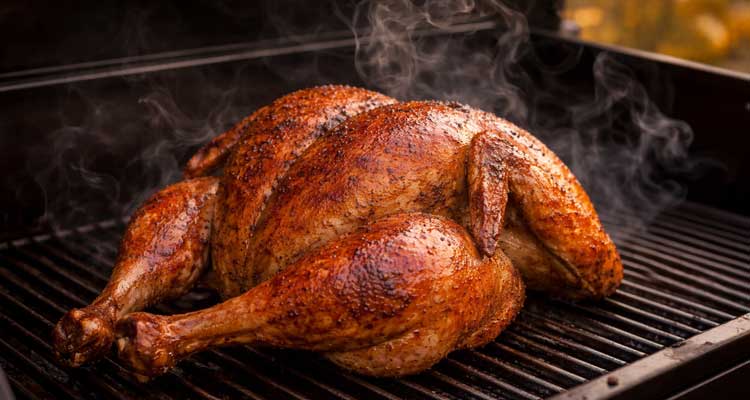
It’s the night before Thanksgiving and your pellet hopper is topped off. You’ve got a 14-pound bird thawing in the fridge and a neighborhood that’s about to smell incredible.
Smoking a turkey on a pellet grill is genuinely one of the most rewarding cooks you can do — and this guide covers everything specific to pellet grills: temperature settings, the best wood pellets, and a cook time chart by weight so you can plan your day with confidence.
For the broader method including brine recipes and general prep, check out our complete how to smoke a turkey guide.
Helpful gear for this cook:
- OXO Good Grips poultry shears — make trimming and spatchcocking poultry easier
- Hotec stainless steel kitchen tongs — make turning and moving food easier
- TrendPlain oil sprayer — helps apply a light, even coat before grilling
Why a Pellet Grill Makes Turkey Smoking Easy
A pellet grill earns its place at Thanksgiving more than any other cook. A great smoked turkey starts with consistent temperature control, and pellet grills deliver that automatically — set it and step away.
A charcoal smoker or offset demands constant fire management. That matters enormously on a day when you’re also managing side dishes, guests, and everything else.
The other advantage is consistency. Turkey needs to reach 165°F throughout without drying out, and wild temperature swings are the enemy. Pellet grills maintain within ±5°F of your set point, which means a predictable cook you can actually plan around.
At lower temperatures — 225°F to 250°F — pellet grills produce a clean, mild smoke that works beautifully with the delicate flavor of turkey. Your smoked turkey will have real smoke flavor without the harshness that can come from offset or stick-burning setups.
Choosing the Right Wood Pellets for Turkey
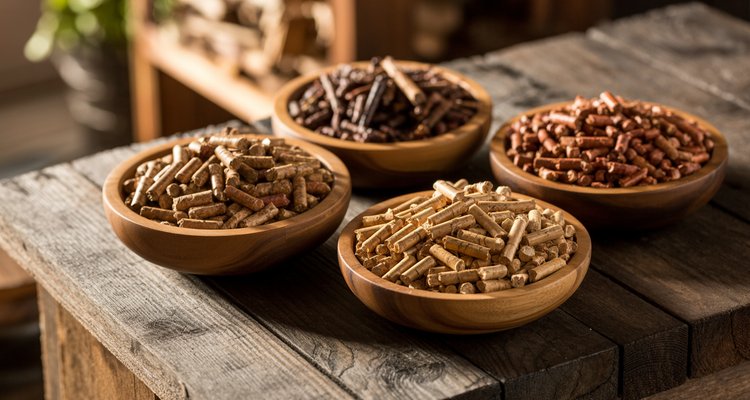
Turkey has a mild, delicate flavor. The goal of your pellet choice is to complement — not overpower — your smoked turkey. Lighter fruit woods and nut woods work best. Bold woods like hickory can work in a blend but should never be used alone for a whole turkey.
Recommended Wood Pellets for Turkey
- Apple: The most popular choice for a reason. Burns clean, produces a light sweet smoke, and adds a faint fruity note that pairs perfectly with poultry. If you’re unsure what to use, start here.
- Cherry: Adds a deeper mahogany color to the skin alongside a mild, slightly sweet smoke. A beautiful finishing wood, especially for that deep reddish-brown exterior.
- Pecan: Sits between fruit wood and hardwood — slightly nuttier and more robust than apple, with more body. A 50/50 blend of apple and pecan is the most versatile all-around choice.
- Hickory: Best used as a minor component in a blend — no more than 25-30% of your fuel mix. Alone, it’s too assertive for a four-to-six-hour turkey cook and can produce a bitter flavor on the skin.
- Competition blend: Usually a mix of hickory, cherry, and maple. Works well if that’s what you have loaded — the fruit woods balance the hickory, making this a solid default option.
- Mesquite — avoid for turkey. It’s the most intense smoke available and will overwhelm the bird over a long cook. Reserve it for brisket and beef.
| Wood Pellet | Flavor Profile | Smoke Intensity | Skin Color | Best For |
|---|---|---|---|---|
| Apple | Light, sweet, fruity | Mild | Golden | First-timers, whole bird |
| Cherry | Mild, sweet, slightly tart | Mild | Deep mahogany | Color + presentation |
| Pecan | Nutty, rich, slightly sweet | Medium | Golden-brown | Best in apple/pecan blend |
| Hickory | Bold, bacon-like, smoky | Strong | Dark brown | Blends only (25-30%) |
| Competition Blend | Balanced, complex | Medium | Rich brown | General use, all-around |
| Mesquite | Intense, earthy, pungent | Very Strong | Very dark | Avoid for turkey |
Pellet Grill Temperature Strategies for Smoking Turkey
There’s no single right temperature for pellet grill turkey — it depends on what you prioritize: maximum smoke flavor, shortest total cook time, or the crispiest skin. Here are the three most common approaches.
Low and Slow at 225°F
Cooking at 225°F gives you the deepest smoke penetration and the most smoke ring. The turkey spends the most time in the ideal smoke absorption window (below 140°F internal temp), which means maximum flavor.
The downside: total cook time is long — roughly 30 minutes per pound — and the skin often comes out rubbery rather than crispy.
Best for: Overnight cooks, maximum smoke flavor, when you don’t mind soft skin or plan to broil briefly at the end.
Middle Ground at 250°F
At 250°F you get most of the smoke flavor benefit with a noticeably shorter cook. The turkey spends enough time below 140°F to absorb real smoke flavor, but finishes faster.
This is the sweet spot for most pellet grill turkey cooks — good smoke, manageable timing, better skin than 225°F.
Best for: Most cooks. Balances smoke flavor with practical timing.
High Heat at 325°F
Running at 325°F from start to finish produces the crispiest skin of all three methods. The bird finishes in roughly half the time of a 225°F cook. Smoke flavor is lighter — pellet grills produce less visible smoke at higher temps — but the skin is significantly better.
Many competition-style cooks use a two-stage approach: 225°F for the first 2-3 hours for smoke, then bump to 325°F to finish and crisp.
Best for: Crispy skin priority, time-constrained cooks, the two-stage method.
| Method | Grill Temp | Smoke Flavor | Skin Result | Cook Multiplier |
|---|---|---|---|---|
| Low & Slow | 225°F | Maximum | Soft/Rubbery | ~30 min/lb |
| Sweet Spot | 250°F | High | Better | ~25 min/lb |
| High Heat | 325°F | Lighter | Crispy | ~15 min/lb |
| Two-Stage | 225°F → 325°F | High | Crispy | Best of both |
Pellet Grill Turkey Cook Time Chart
Always smoke to internal temperature, not time. Every smoked turkey is shaped differently, and ambient temperature, wind, and hopper pellet quality all affect cook time.
Use these times for planning your turkey — budget an extra 30-45 minutes as a buffer, and always have your thermometer in the bird well before you expect it to be done.
Target internal temperatures: Breast — 165°F. Thigh — 175°F. Check the thigh; it’s the last part to reach temperature and the best indicator the bird is fully cooked.
| Turkey Weight | At 225°F | At 250°F | At 325°F | Target Temp |
|---|---|---|---|---|
| 10 lbs | 4.5–5 hrs | 3.5–4 hrs | 2–2.5 hrs | 165°F breast / 175°F thigh |
| 12 lbs | 5.5–6 hrs | 4.5–5 hrs | 2.5–3 hrs | 165°F breast / 175°F thigh |
| 14 lbs | 6.5–7 hrs | 5.5–6 hrs | 3–3.5 hrs | 165°F breast / 175°F thigh |
| 16 lbs | 7.5–8 hrs | 6.5–7 hrs | 3.5–4 hrs | 165°F breast / 175°F thigh |
| 18 lbs | 8.5–9 hrs | 7–7.5 hrs | 4–4.5 hrs | 165°F breast / 175°F thigh |
| 20 lbs | 9.5–10 hrs | 8–8.5 hrs | 4.5–5 hrs | 165°F breast / 175°F thigh |
Note: Times are estimates for whole birds at room temperature after resting in the fridge. Add 30–45 min buffer. Turkey breast (boneless) cooks significantly faster — roughly 1.5–2 hours at 250°F for a 4-5 lb breast.
Preparing Your Turkey for the Pellet Grill
Thaw Completely Before You Smoke
Never smoke a frozen or partially frozen turkey. The outside will cook long before the center reaches a safe temperature.
Thaw in the refrigerator — allow 24 hours for every 4-5 pounds. A 14-pound bird needs 3 full days in the fridge.
To Brine or Not
Brining is highly recommended for smoked turkey. The low, slow cooking environment can draw moisture out of the meat, and brining counteracts that by saturating the cells with seasoned liquid in advance (a BBQ seasoning sampler works great if you want to experiment with flavors without committing to a full jar).
A wet brine (water, salt, sugar, herbs) delivers the most moisture retention but requires submerging a 14-pound bird for 12-24 hours — which needs a very large container and fridge space.
A dry brine (salt and spices rubbed directly on and under the skin) is more practical and still delivers great results.
For full brine recipes and detailed instructions, see our how to smoke a turkey guide.
Important: If your turkey is pre-brined or labeled “enhanced” (injected with a saline solution), skip the brine. Double-brining makes it unpleasantly salty.
Prep Steps
- Remove giblets and neck from both cavities — check both ends
- Rinse under cold water and pat completely dry with paper towels
- Gently separate the skin from the breast meat and rub softened butter with herbs directly onto the meat underneath
- Season the exterior generously with your favorite poultry rub
- Stuff the cavity loosely with aromatics: quartered onion, celery, garlic, fresh rosemary, and halved citrus — these add internal moisture and flavor, not stuffing for eating
- Tie the legs together with butcher’s twine to keep the shape compact for even cooking
Setting Up Your Pellet Grill for Turkey
Startup and Priming
If you’ve recently cleaned your auger or changed pellet flavors, prime the auger before setting your cook temp. Most pellet grills have a dedicated startup procedure — consult your manual.
For Traeger, use the startup sequence; for Pit Boss, run through the initial prime if switching pellets. This prevents misfires and ensures clean ignition.
Hopper Capacity for Long Cooks
A 14-pound turkey at 225°F runs 6.5-7 hours. Most full-size pellet grills burn 1-2 lbs of pellets per hour at low temps — that’s 7-14 lbs of pellets for the cook.
Always start with a full hopper. For very large birds at 225°F, check the hopper at the 4-5 hour mark and top off if needed. Running out of pellets mid-cook drops the temperature and can stall your cook badly.
Preheat to Target Temperature
Set your grill to your target temp and preheat with the lid closed for 15-20 minutes. A fully preheated grill means cleaner initial smoke and more accurate temperature readings when you place the turkey.
Super Smoke, P-Settings, and Smoke Output
One trade-off unique to pellet grills: smoke output drops at higher temperatures. Here’s how to maximize smoke on your specific grill:
- Traeger: If your grill has Super Smoke mode, enable it for the first 2-3 hours of the cook. Super Smoke maximizes smoke output at low temps (below 225°F) by cycling the auger differently. After that, bump to your finishing temp.
- Pit Boss: Use the P-setting to control smoke output. The P-setting (P4 is default) controls how long the auger pauses between cycles — a higher P number means more smoke but lower average temperature. Try P5 or P6 at 225°F for more smoke production early in the cook.
- Camp Chef: Enable the Smoke Control feature (also called “High Smoke” mode on some models) at the start of the cook. Like Super Smoke, it maximizes smoke output at lower temperature settings.
Using a Water Pan
Place a foil pan filled with water on the grill grate, positioned next to (not under) the turkey. The water adds moisture to the cooking chamber, which helps smoke adhere to the skin and keeps the bird from drying out during a long low-and-slow cook.
It also helps moderate temperature swings.
Step-by-Step: Smoking the Turkey on Your Pellet Grill
Step 1: Place the Turkey and Insert the Probe
Place the turkey breast-side up on the center of the grill grate. Breast-side up throughout is the most common approach for pellet grill turkey — it keeps the smoke circulating evenly around the whole bird.
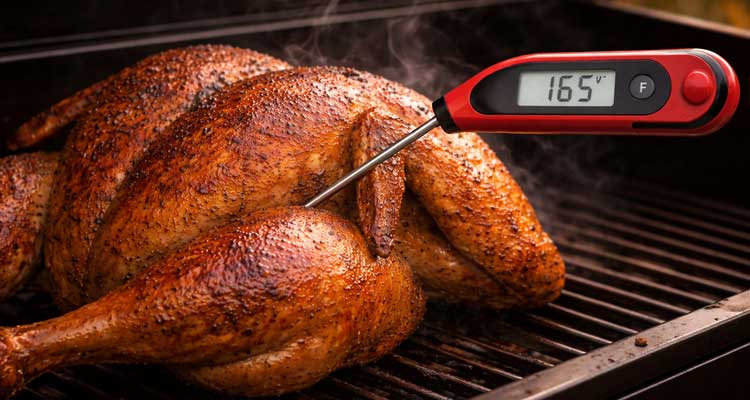
Insert your leave-in probe thermometer into the thickest part of the breast, angling slightly toward the center and away from the bone. Insert a second probe into the thigh if your thermometer supports it.
Step 2: The Smoke Absorption Phase (First 2-3 Hours)
Close the lid and let the turkey smoke at your target low temp (225-250°F) for the first 2-3 hours. This is the window where smoke penetrates deepest — once the internal temp climbs above 140°F, smoke absorption drops off significantly.
Don’t open the lid during this phase. Every lid lift drops the temperature 25-50°F and extends your cook time.
Step 3: Optional Temperature Bump for Crispy Skin
After the initial smoke phase (around the 2.5-3 hour mark, or when the internal breast temp hits 100-110°F), bump your pellet grill up to 325°F.
This is the two-stage method: you’ve captured your smoke flavor, now you’re using heat to render the fat under the skin and crisp it up. Continue cooking at 325°F until the breast hits 165°F and the thigh hits 175°F.
Step 4: Monitor Internal Temperature Throughout
Don’t leave for an extended period without checking. Plan for the cook time from the chart above, and set a timer to check the probe every 45-60 minutes in the final stretch.
Pull the turkey when the breast reaches 160-162°F — carryover heat will bring it to 165°F during the rest.
Step 5: Rest 30 Minutes Before Carving
Transfer the turkey to a cutting board, tent loosely with foil, and rest for at least 30 minutes. Resting allows the juices to redistribute throughout the meat.
Cut into a turkey too soon and those juices run straight out onto the cutting board. After 30 minutes, carve and serve.
How to Get Crispy Skin on a Pellet Grill Turkey
Rubbery skin is the most common complaint about pellet grill smoked turkey, and it’s almost entirely a pellet grill issue. The low, moist cooking environment that makes the meat juicy works against skin crispiness. Here’s how to fight back:
Air-Dry the Turkey Overnight
After brining and patting dry, place the turkey uncovered on a rack in your refrigerator overnight (8-12 hours). The cold, dry fridge air wicks moisture off the skin surface.
A dry-surface turkey crisps dramatically faster than a moist one.
The Baking Powder Trick
Before smoking, dust the skin lightly with baking powder (not baking soda). Baking powder is slightly alkaline, which raises the skin’s pH and accelerates the Maillard reaction — the same browning chemistry behind great bark on brisket.
Use sparingly — about 1/2 teaspoon per 5 lbs of turkey.
The Temperature Bump Finish
As covered in Step 3 above, bumping to 325°F in the final stage of the cook is the single most effective strategy for crispy pellet grill turkey skin.
If you cooked entirely at 225°F, you can still rescue the skin: when the breast hits about 155°F, crank the grill to 400°F for the final 20-30 minutes.
The Spatchcock Method for Faster, Crispier Results
Spatchcocking (removing the backbone and flattening the turkey) exposes more surface area to direct heat and dramatically reduces cook time.
A spatchcocked 14-pound turkey at 325°F on a pellet grill cooks in roughly 2-2.5 hours — and the skin is nearly uniformly crispy because the whole surface faces the heat. If crispy skin is your top priority, this is the method to use.
See our complete guide on how to spatchcock a turkey for step-by-step instructions.
Troubleshooting Your Pellet Grill Turkey
Turkey Taking Too Long
If you’re running behind schedule, raise the grill temp to 275-300°F. The turkey will finish faster without a significant impact on juiciness (especially if it was brined).
Smoke flavor won’t suffer much at this range — it’s still in the productive smoke window.
Not Getting Enough Smoke Flavor
This is a common pellet grill frustration. Try these fixes:
- Enable Super Smoke/high smoke mode for the first 2-3 hours
- Start with a cold turkey straight from the fridge — colder meat condenses smoke and absorbs it more readily
- Adjust P-settings higher (Pit Boss/Camp Chef)
- Add a smoke tube filled with pellets alongside the turkey for supplemental smoke at any temperature
Skin Getting Too Dark or Burning
If the skin is taking on too much color before the internal temp is where you want it, tent loosely with aluminum foil.
A foil tent blocks direct radiant heat while allowing the grill’s convection to continue cooking the interior. Remove the foil tent in the last 30 minutes to let the skin firm up.
Pellets Running Out Mid-Cook
If your grill loses temperature unexpectedly during a long cook, check the hopper first — this is the most common cause.
A pellet bridge (pellets arching over the auger) can prevent flow even when the hopper looks full. Break up any bridge with a wooden spoon. For cooks over 7 hours, plan a hopper check at the midpoint.
Frequently Asked Questions
How long does it take to smoke a turkey at 225°F on a pellet grill?
At 225°F, plan on approximately 30 minutes per pound for your smoked turkey. A 12-pound turkey takes 5.5–6 hours; a 16-pound bird takes 7.5–8 hours.
Always budget an extra 30-45 minutes and cook to internal temperature (165°F breast, 175°F thigh) rather than a set time.
Is it better to smoke a turkey at 225 or 275 on a pellet grill?
Both work well, with different trade-offs. At 225°F you get more smoke flavor but softer skin and a longer cook. At 275°F the cook is 30-40% faster and skin results are better, with slightly less smoke penetration.
Most experienced pellet grill cooks prefer 250-275°F as the practical sweet spot, or use the two-stage method (225°F for the first few hours, then 325°F to finish).
What internal temperature should a smoked turkey reach?
The breast must reach 165°F and the thighs should reach 175°F. The thigh takes longer because it’s denser — always check the thigh before declaring the turkey done.
Pull the breast off the grill at 160-162°F and carryover cooking during the 30-minute rest will bring it to 165°F.
What are the best wood pellets for smoking turkey?
Apple is the most popular choice — mild, sweet, and complements poultry without overpowering it. A 50/50 apple and pecan blend is excellent for more body. Cherry adds beautiful color.
Avoid mesquite for whole turkey; it’s too intense over a 5-7 hour cook. Competition blend pellets (hickory/cherry/maple mix) work well as a general-purpose option.
How do I get crispy skin on a pellet grill smoked turkey?
The most effective approach combines three techniques:
- Air-dry your turkey uncovered in the fridge overnight after brining
- Dust the skin lightly with baking powder before smoking
- Bump the grill temp to 325°F in the final stage of the cook
If you still want crispier skin, finish at 400°F for the last 20 minutes. The spatchcock method produces the crispiest smoked turkey results of all.
Do I need to brine a turkey before smoking it on a pellet grill?
It’s not required, but it’s strongly recommended. Low-and-slow smoking can draw moisture out of the meat, and brining counteracts this by pre-saturating the turkey with seasoned liquid.
Even a simple overnight dry brine (salt rubbed on and under the skin) makes a noticeable difference in juiciness. Skip brining only if your turkey is already pre-brined or labeled “enhanced.”
Can I smoke a frozen turkey on a pellet grill?
No. Never smoke a frozen or partially frozen turkey. The exterior reaches unsafe temperatures while the interior is still frozen — creating a bacteria risk.
Thaw completely in the refrigerator first: allow 24 hours per every 4-5 pounds of turkey.
How much smoke does a pellet grill produce at higher temperatures?
Less than at lower temperatures. Pellet grills produce the most visible smoke between 180°F and 250°F grill temp. Above 275°F, combustion becomes more complete and smoke output drops noticeably.
This is why the two-stage method (low start, high finish) captures the best of both: maximum smoke flavor early, then higher heat for skin. Use Super Smoke mode (Traeger) or a smoke tube at higher temps to compensate.
Should I use a water pan when smoking turkey on a pellet grill?
Yes, especially for low-and-slow cooks at 225-250°F. A water pan adds humidity to the cooking chamber, which helps smoke adhere to the skin and prevents the breast meat from drying out.
Place it on the grate beside the turkey (not directly under it). For high-heat cooks at 325°F+, the water pan is less critical but still useful.
How do I know when my smoked turkey is done?
Use a leave-in probe thermometer. Pull the turkey when the breast reaches 160-162°F and the thigh reaches 175°F.
Don’t rely on the pop-up timer included with most store-bought turkeys — they’re set to trigger at 180°F, which overcooks the breast. The juices running clear when you pierce the thigh is a secondary check, but temperature is the only reliable indicator.
How long does it take to smoke a 20 lb turkey at 250°F?
A 20-pound turkey at 250°F takes approximately 8–8.5 hours, based on the 25 min/lb estimate. Plan on 9 hours with a buffer.
For a large bird like this, the two-stage method works particularly well — start at 225°F for 3 hours to build smoke flavor, then raise to 325°F for the remainder to keep total cook time manageable.
Can I smoke a turkey breast on a pellet grill, and how does timing differ?
Yes — a bone-in turkey breast (4-7 lbs) smokes beautifully on a pellet grill and cooks much faster than a whole bird. At 250°F, a 5-pound bone-in breast takes 2–2.5 hours. A boneless breast takes 1.5–2 hours at 250°F.
The same temperature targets apply: 165°F internal. Turkey breast is more prone to drying out than dark meat, so brining is especially important for breast-only cooks.