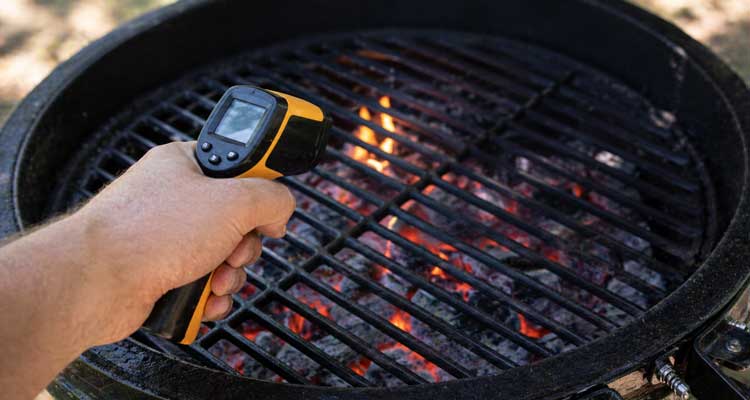
Knowing the exact surface temperature of your grill grate is an overlooked BBQ skill. Experts emphasize that surface heat drives the Maillard reaction for a perfect sear. An infrared grill thermometer gives you that precise surface reading instantly, without contact.
Quick Roundup List
- Best Overall Value: XinJiaYi Laser Temperature Gun (Yellow)
- Best Premium/Professional: ennoLogic eT650D Temperature Gun
- Best Distance Ratio: TempPro TP450 2 Laser Temperature Gun
- Best Compact: TempPro TP30 Infrared Thermometer Gun
- Best Alternative Color: XinJiaYi Laser Temperature Gun (Gray)
| Model | Temp Range | D:S Ratio | Emissivity | Best For | Link |
|---|---|---|---|---|---|
| XinJiaYi (Yellow) | -58°F to 1022°F | 12:1 | 0.1–1.0 | Best Overall Value | See at Amazon |
| ennoLogic eT650D | -58°F to 1202°F | 10:1 | Adjustable | Best Premium | See at Amazon |
| TempPro TP450 | -58°F to 1022°F | 16:1 | 0.1–1.0 | Best Distance Ratio | See at Amazon |
| TempPro TP30 | -58°F to 1022°F | 12:1 | 0.1–1.0 | Best Compact | See at Amazon |
| XinJiaYi (Gray) | -58°F to 1022°F | 12:1 | 0.1–1.0 | Best Alt. Color | See at Amazon |
Quick Summary
Infrared thermometers measure grill grate surface temperature instantly without contact, which is critical for timing sears and verifying hot spots. Key specs include adjustable emissivity for reading different surface materials, distance-to-spot ratios ranging from 12:1 up to 16:1, and maximum temperature thresholds between 750 and 1200 degrees Fahrenheit.
- Precision Searing — Infrared thermometers provide instant, non-contact surface temperature readings, crucial for achieving the perfect sear and Maillard reaction on grill grates, pizza stones, or cast iron.
- Key Features — Look for adjustable emissivity to get accurate readings on various surfaces (like shiny stainless steel vs. matte cast iron) and a good distance-to-spot ratio for safe measurements over high heat.
- Top Picks — The XinJiaYi offers great value for everyday use, while the ennoLogic eT650D provides professional-grade precision with dual lasers and a high temperature threshold. The TempPro TP450 excels with a superior 16:1 D:S ratio for safer long-distance readings.
- Not for Internal Temps — Remember, these tools measure surface heat only. Always use a separate probe thermometer for accurate internal meat doneness to ensure food safety.
Top Infrared Grill Thermometers Reviewed
These infrared thermometers measure surface temperature only. They are not a substitute for a probe thermometer when checking internal meat doneness. Use them to verify your grill grates, pizza stone, or cast iron skillet has reached the right heat before cooking.
 Pitmaster Tip:
Always point your infrared thermometer at a non-shiny surface for the most accurate reading. Shiny stainless steel grates reflect infrared energy and can produce readings 50–100°F lower than actual temperature. Use the adjustable emissivity setting to compensate.
XinJiaYi Laser Temperature Gun (Yellow) – Best Overall Value

The XinJiaYi Laser Temperature Gun (Yellow) shines on flat-top surfaces like Blackstone griddles. Point it across your griddle surface to instantly map where temperatures differ, so you can move food strategically. The wide temperature range and quick response time make it a practical everyday BBQ tool.
Highlights
- Wide temperature range up to 1022°F
- Adjustable emissivity (0.1–1.0) for different grate materials
- Quick response time of 0.5 seconds
Specifications
- Temp Range: -58°F to 1022°F
- D:S Ratio: 12:1
- Display: Backlit LCD
Customer Reviews
- “Very handy tool — I use it on my griddle so I know the temp of my cooking surface. Very accurate and easy to use.”
- “Great for learning the Blackstone. Now I can track temps and really start to perfect my recipes — I understand my cool zones and how to move food around to take advantage of thermal differences.”
ennoLogic eT650D Temperature Gun – Best Premium/Professional

The ennoLogic eT650D is built for high-heat environments where precision matters most. Its dual-laser system visually frames the measurement zone, making it ideal for targeting the center of a pizza stone. The 1202°F maximum threshold handles intense cooking setups.
Highlights
- Dual lasers for precise targeting area visualization
- High maximum temperature threshold of 1202°F
- Scan & Hold with Hi/Lo Alarms
Specifications
- Temp Range: -58°F to 1202°F
- D:S Ratio: 10:1
- Features: Min, Max, and Average display
Customer Reviews
- “Higher max temp capability than most of the competition, plus min/max/avg display — does a great job with that. Exactly what I was looking for.”
- “I love this thermometer — use it for cooking, refrigeration, HVAC, and computer cooling systems. Incredibly versatile for everything that requires a thermometer.”
- “Far better than cheaper IR thermometers. Quality control is a priority — each unit checked thoroughly before sale and backed by a 10-year warranty. The features alone make it worth the price.”
Pro Tip:
For the most accurate results with the ennoLogic, position yourself about 8 inches from the surface so the dual laser dots frame the exact spot you want to measure. At greater distances, the measured area grows wider than you may intend.
TempPro TP450 2 Laser Temperature Gun – Best Distance Ratio
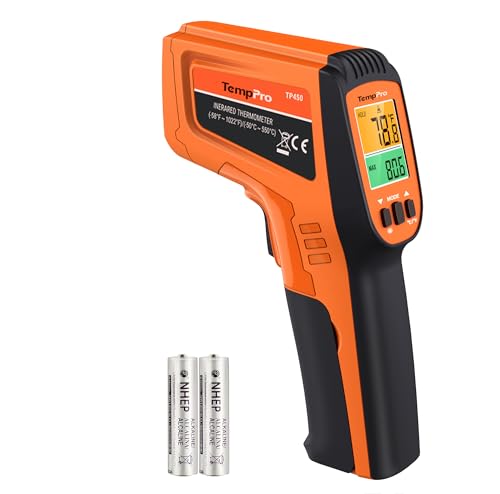
The TempPro TP450 2 Laser Temperature Gun’s 16:1 distance-to-spot ratio is the standout feature here, letting you measure a 1-inch target from 16 inches away. You can safely take readings of a blazing charcoal bed without leaning over intense heat. Dual lasers confirm you are targeting the right spot.
Highlights
- Superior 16:1 distance-to-spot ratio for safer measuring
- Dual laser targeting for accuracy
- Data tracking with MAX/MIN/AVG functions
Specifications
- Temp Range: -58°F to 1022°F
- D:S Ratio: 16:1
- Accuracy: +/- 1.5%
Customer Reviews
- “Quick and easy — just point, pull the trigger, and get an instant reading. The display is clear and easy to read even in lower light conditions.”
- “Works really well and is extremely easy to use. Perfect for cooking, grilling, pizza ovens, and checking surface temperatures around the house. The laser makes it easy to aim.”
- “Versatile non-contact measurement tool that’s as useful in the kitchen as in the garage — much more capable than basic entry-level models.”
TempPro TP30 Infrared Thermometer Gun – Best Compact

The TempPro TP30 Infrared Thermometer Gun is the everyday workhorse for backyard BBQ. It is perfectly suited for checking a cast iron skillet before dropping in a steak. The adjustable emissivity handles both seasoned cast iron and raw stainless steel surfaces with equal reliability.
Highlights
- Adjustable emissivity for various surface materials
- Ultra-fast response time under 500ms
- Auto shut-off feature to conserve battery
Specifications
- Temp Range: -58°F to 1022°F
- D:S Ratio: 12:1
- Sensor: Thermopile sensor technology
Customer Reviews
- “Quick and easy to use — just point, pull the trigger, and get an instant reading. The display is clear and easy to read, even in lower light.”
- “Readings are quick and accurate, perfect for grilling and pizza ovens. The laser makes it easy to aim precisely at the surface you want to measure.”
- “Works great for checking oven temperatures, grill grates, and surface temps around the house — also useful for diagnosing insulation leaks. Accurate and consistent every time.”
XinJiaYi Laser Temperature Gun (Gray) – Best Alternative Color

The XinJiaYi Laser Temperature Gun (Gray) delivers the same proven performance as the yellow XinJiaYi, with identical temperature range, D:S ratio, and emissivity settings. The sleek gray color suits those who prefer a more neutral tool aesthetic on the grill station.
Highlights
- Versatile applications from BBQ to home maintenance
- Anti-slip, portable design
- Includes carrying pouch and batteries
Specifications
- Temp Range: -58°F to 1022°F
- D:S Ratio: 12:1
- Emissivity: Adjustable 0.1–1.0
Customer Reviews
- “Very handy tool — use it on my griddle to know the temp of my cooking surface. Very accurate and does exactly what it says.”
- “Great for the Blackstone. Now I can track temps and perfect my recipes — I understand cool zones and how to move food strategically across the cooking surface.”
Buying Advice: Choosing the Best Infrared Grill Thermometer
Prioritize adjustable emissivity if you cook on multiple grate materials, since shiny stainless steel reads differently than matte cast iron at the same temperature. A higher distance-to-spot ratio like 16:1 lets you measure from farther away, reducing heat exposure. Infrared thermometers read surface temperature only and cannot replace a probe thermometer for internal meat doneness. The best infrared grill thermometer for you depends on what you cook and how you cook it. For most backyard BBQ setups, a 12:1 D:S ratio with adjustable emissivity covers everything from grill grates to pizza stones. Brands like ennoLogic and TempPro have built strong reputations for accuracy in this category. The key differentiator is adjustable emissivity. It allows the thermometer to compensate for different surface materials, which is critical for reliable readings. If you work with extremely high-heat setups like wood-fired ovens, prioritize a model with a higher maximum temperature threshold. If you frequently measure from a distance over open flames, the 16:1 ratio of the TempPro TP450 offers a meaningful safety advantage.
Pitmaster Tip:
Remember that an infrared thermometer only tells you what the surface is doing. For internal meat doneness, you still need a dedicated probe thermometer. Use both for complete cooking control.
Frequently Asked Questions
Do infrared thermometers work for grilling?
Yes — infrared thermometers are excellent tools for grilling. They instantly measure the surface temperature of grill grates, pizza stones, and cast iron skillets without contact. This tells you whether your cooking surface is hot enough to sear. One critical point: an infrared thermometer measures surface temperature only. It cannot measure the internal temperature of meat. For food safety and doneness, always use a probe-style thermometer to check the center of your protein.
What are the disadvantages of using an infrared thermometer?
The main limitation is that infrared thermometers read surface temperature only. They tell you nothing about what is happening inside a piece of meat. They also require a clear, unobstructed line of sight to the surface being measured. Reflective surfaces like polished stainless steel grates can throw off readings, because shiny materials reflect infrared energy rather than emitting it accurately. This is why adjustable emissivity is such an important feature.
What is the most accurate grilling thermometer?
The answer depends on what you are measuring. For surface temperature accuracy, an infrared thermometer with adjustable emissivity delivers reliable readings when set correctly for the surface material. For internal meat temperature, a high-quality instant-read probe thermometer is the gold standard. The two tools serve different purposes and work best together. Use the infrared grill thermometer to confirm your grill is properly preheated.
What does the distance-to-spot ratio mean?
The D:S ratio tells you how far away you can stand while still measuring a precise 1-inch area. A 12:1 ratio means you can be 12 inches from the surface and read a 1-inch spot. Higher ratios are valuable when measuring hot surfaces that you need to stay away from, like a blazing charcoal bed or a high-heat pizza oven floor. For standard grill grate checks, a 12:1 ratio is plenty precise.
What is emissivity and why does it matter for grilling?
Emissivity is a measure of how efficiently a surface radiates infrared energy. A setting of 1.0 represents a perfect emitter, while shiny or reflective surfaces have values closer to 0.1. Matte black cast iron has high emissivity. Adjusting the emissivity setting on your infrared thermometer to match the surface material produces far more accurate readings. Most grills use cast iron or porcelain-coated grates, which are generally well-suited to readings near the default range.
Take Home Message
An infrared thermometer helps you verify that grill grates reach the 450–700°F range needed for a proper Maillard reaction sear. It also reveals cold spots and uneven heating across the cooking surface. Always pair it with an internal probe thermometer to confirm meat reaches safe finished temperatures for food safety. An infrared grill thermometer is an indispensable tool for any serious griller, providing instant, accurate surface temperature readings that are crucial for perfect searing and cooking control. Remember to always pair it with a probe thermometer for internal meat temperatures, ensuring both delicious results and food safety.