You’ve got a thick ribeye resting on the cutting board, thermometer in hand – and suddenly you’re not sure what number you’re actually chasing. Is it 145°F? 135°F? Does it matter which protein you’re cooking? It does. This guide covers the internal meat temperature for every major protein – beef, pork, chicken, fish, and lamb – with both USDA safe minimums and chef-recommended targets so you can cook with confidence.
Internal Meat Temperature Chart
The table below is your complete at-a-glance reference. Pull temperatures are what you take the meat off the heat at – final temperature after resting is listed separately where carryover cooking is significant.
| Protein | Cut | USDA Safe Temp | Chef Recommended | Rest Time |
|---|---|---|---|---|
| Beef | Steaks & Roasts | 145°F (63°C) | 130-135°F (medium-rare) | 5 min (steaks), 20-30 min (roasts) |
| Beef | Ground Beef | 160°F (71°C) | 160°F (no exceptions) | None required |
| Pork | Chops & Roasts | 145°F (63°C) | 145°F (same as USDA) | 3-5 min |
| Pork | BBQ Ribs / Pulled Pork | 145°F (63°C) | 195-205°F (texture target) | 15-30 min |
| Chicken | All Cuts (breast, thighs) | 165°F (74°C) | 165°F breast; 175°F thighs | 5 min |
| Turkey | Whole Bird / Parts | 165°F (74°C) | 165°F | 20-30 min (whole) |
| Fish | All Types | 145°F (63°C) | 125-135°F (salmon/tuna) | 2-3 min |
| Lamb | Chops & Roasts | 145°F (63°C) | 130-135°F (medium-rare) | 5-10 min |
| Lamb | Ground Lamb | 160°F (71°C) | 160°F (no exceptions) | None required |
| Venison / Game | Steaks & Roasts | 160°F (71°C) | 130-145°F (steaks) | 5-10 min |
- Everyday checks: AMMZO digital meat thermometer works for quick spot checks across steaks, chicken, and pork.
- Multi-probe cooks: INKBIRD wireless meat thermometer tracks multiple cuts during longer smoker or oven sessions.
- Fast readings: INKBIRD instant-read thermometer helps confirm final doneness before resting.
- Instant-read option: ThermoMaven instant-read meat thermometer fits fast spot checks across steaks, chops, poultry, and fish.
- Leave-in option: ThermoMaven wireless meat thermometer is useful for longer BBQ cooks where internal temperature changes slowly.
How to Take an Internal Meat Temperature
Before diving into protein-specific numbers, it helps to understand the fundamentals – because even a perfect target temperature is useless if the thermometer is in the wrong spot or poorly calibrated.
Where to Insert a Meat Thermometer
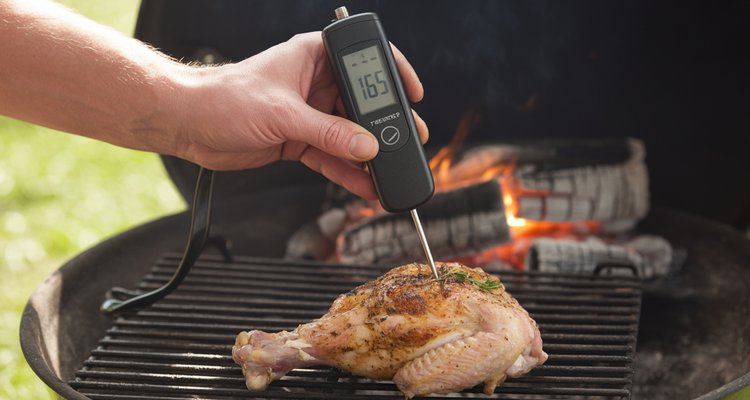
Always insert the probe into the thickest part of the meat, away from bone, fat pockets, or gristle. Bone conducts heat faster than muscle tissue, so a reading near the bone will be higher than the actual center temperature. For steaks and chops, go in from the side – straight down through the top gives you a shallow read that’s often 10-15°F hotter than the true center. For whole birds, check the innermost part of the thigh (where it meets the body) and the thickest part of the breast separately. The thigh takes longer to cook and will lag behind the breast.
Understanding Carryover Cooking
Carryover cooking is the temperature rise that continues after you pull meat from the heat. The exterior of the meat is hotter than the core, and that heat keeps migrating inward during the rest period. If you pull a steak right at your target, it’ll overshoot.
- Steaks and chops: expect +3-5°F of carryover rise during resting
- Roasts and whole birds: expect +10-15°F of carryover rise
The practical rule: pull steaks 3-5°F below your target and roasts 10-15°F below. Rest on a cutting board – not back on a hot pan – and let carryover do its job.
Rest Time by Cut
| Cut | Recommended Rest Time | Carryover Rise |
|---|---|---|
| Steaks (under 1.5 in) | 5 minutes | +3-5°F |
| Thick steaks / chops (1.5 in+) | 5-10 minutes | +5-8°F |
| Pork ribs | 15 minutes | +5°F |
| Pork shoulder / brisket | 30-60 minutes (foil wrap) | +10-15°F |
| Roasts (3-6 lbs) | 20-30 minutes | +10-15°F |
| Whole turkey / chicken | 20-30 minutes | +10-15°F |
How to Calibrate Your Thermometer
A thermometer that reads 5°F off can be the difference between perfectly cooked and overcooked. Calibrate every few months – or any time the thermometer is dropped. Ice-bath method: Fill a glass with crushed ice and cold water. Insert the probe into the ice water, making sure it doesn’t touch the sides or bottom. After 30 seconds it should read 32°F (0°C). If it’s off, use the calibration screw or recalibration function (check your thermometer’s manual). Boiling water method: At sea level, boiling water is 212°F (100°C). Adjust for altitude – water boils at approximately 202°F at 5,000 feet elevation.
Beef Internal Temperature
Steak Doneness Temperatures
Beef steak is the protein where the USDA recommendation and chef preference diverge most sharply. The USDA minimum of 145°F lands solidly in medium territory – most experienced cooks pull steaks at 130-135°F (medium-rare), well below that threshold. Use the steak temperature chart below as your reference for every doneness level.
| Doneness | Pull Temp | Final Temp (after rest) | Description |
|---|---|---|---|
| Rare | 120°F | 125°F | Cool red center, very soft |
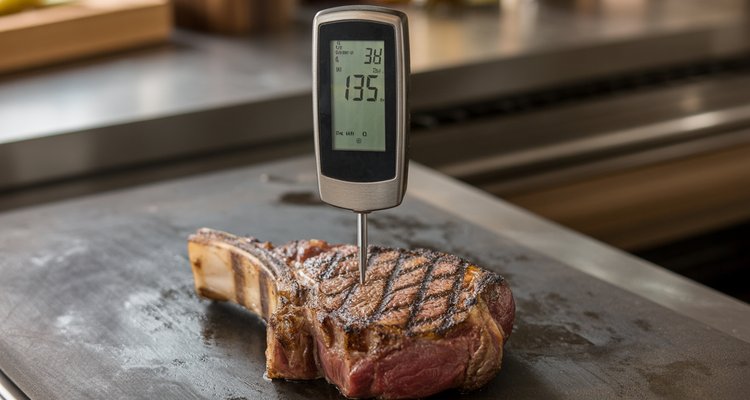
| Medium-Rare | 130°F | 135°F | Warm red-pink center, juicy – chef standard |
| Medium | 140°F | 145°F | Pink center, firm – USDA minimum |
| Medium-Well | 150°F | 155°F | Slightly pink, firmer texture |
| Well Done | 160°F | 165°F+ | No pink, fully cooked through |
Why do chefs prefer medium-rare below the USDA minimum? On a whole muscle steak, harmful bacteria live only on the exterior surface – and the sear kills them on contact. The interior of an intact cut is sterile. The USDA’s 145°F builds in a safety margin designed for home kitchens with potentially uncalibrated thermometers, but it’s not required for pathogen destruction in whole muscle cuts. For a deep dive on steak doneness, see our complete steak temperature guide.
Beef Roasts and Whole Cuts
Prime rib, chuck roast, tri-tip, and other whole beef cuts follow the same doneness scale as steaks. The USDA minimum is 145°F with a 3-minute rest. For a medium-rare prime rib, pull at 125-128°F and rest 20-30 minutes – carryover will bring it to 135-138°F.
Ground Beef Temperature
Ground beef is non-negotiable: always 160°F. When meat is ground, any bacteria on the surface gets mixed thoroughly throughout the patty – so you can’t rely on the sear to make the interior safe. This applies to burgers, meatballs, and meatloaf. Color is not a reliable indicator; a burger can look brown while still harboring pathogens below 160°F.
Pork Internal Temperature
Pork Chops and Roasts
The USDA updated its pork guidelines in 2011, dropping the safe minimum from 160°F to 145°F with a 3-minute rest for whole cuts. This was a significant shift – and it means pork chops can now be served with a hint of pink in the center, similar to a medium beef steak. The pink color that persists in properly cooked pork is caused by myoglobin, the same protein responsible for beef’s red color. A pork chop that reads 145°F and has a slightly rosy center is perfectly safe to eat. The 3-minute rest is part of the equation – it’s not just about moisture, it provides the additional pasteurization time that drops the bacterial count to safe levels.
Ground Pork Temperature
Ground pork follows the same rule as ground beef: always 160°F. The grinding process distributes surface bacteria throughout the meat, eliminating the safety margin that whole cuts enjoy.
BBQ Pork Ribs and Pulled Pork
Here’s where BBQ pork diverges sharply from USDA safety targets. Ribs and pulled pork shoulder are safely cooked at 145°F, but they’re not ready to eat – they’re tough and chewy. The target for BBQ pork is 195-205°F, which is a texture target, not a safety target. The science: pork contains a protein called collagen that surrounds the muscle fibers. Collagen is tough and chewy below 160°F. Above 160°F it begins converting to gelatin – a process that takes time and temperature. At 195-203°F, collagen fully converts to gelatin, coating the muscle fibers and making the meat tender enough to pull apart cleanly. This is why low-and-slow BBQ requires patience: you’re not just cooking the pork safely, you’re rendering the connective tissue into something delicious.
Chicken and Poultry Internal Temperature
Chicken Breast Internal Temperature
Chicken breast must reach 165°F – the USDA minimum for all poultry – and there’s no chef exception here. Unlike beef, poultry can harbor Salmonella not just on the surface but throughout the muscle tissue, making a medium-rare chicken genuinely dangerous. Pull chicken breast at 160°F and rest 5 minutes; carryover cooking will bring it to 165°F. This technique helps you hit the minimum safely while keeping the breast as juicy as possible.
Chicken Thighs and Dark Meat
Chicken thighs are safe at 165°F, but the eating experience is significantly better at 175-185°F. Dark meat contains more connective tissue and collagen than white meat. At 165°F, that collagen is still firm and slightly chewy. At 175-185°F, it breaks down into gelatin – which is why thighs cooked to that range are juicy and tender in a way that breast meat never is.
Turkey Internal Temperature
Turkey follows the same 165°F rule as chicken. For a whole bird, check the temperature in three places: the innermost part of the thigh (the last part to reach temperature), the thickest part of the breast, and the innermost part of the wing joint. The bird isn’t done until all three locations read 165°F. Whole turkeys carry significant carryover heat – up to 15°F. Pull at 150-155°F in the thigh, tent loosely with foil, and rest 20-30 minutes. The carryover will safely bring it to 165°F+ while keeping the breast from drying out.
Duck and Game Birds
Duck breast is the notable exception in poultry. Its dense, red muscle tissue is more similar to beef than chicken, and it’s commonly served medium-rare (130-135°F) in professional kitchens. The USDA guideline of 165°F for all poultry applies here, so serving duck breast below that is a personal informed choice – ideally with responsibly sourced product. Whole duck should always reach 165°F, as the legs and carcass don’t benefit from the medium-rare treatment.
Fish and Seafood Internal Temperature
Fish (All Types)
The USDA recommends 145°F for all fish. At that temperature, fish will flake easily and cleanly when pressed with a fork – the protein structure becomes opaque throughout. For most white fish like cod, halibut, and tilapia, 145°F produces excellent results.
Salmon Internal Temperature
Salmon is where chefs most commonly depart from USDA guidelines. At 145°F, salmon is fully cooked but can feel dry and slightly chalky. At 125-130°F (medium-rare), it has a silky, buttery texture with a translucent center. At 135°F (medium), it’s moist and just beginning to flake. Most professional kitchens serve salmon at 125-130°F. This is a personal choice – for immune-compromised individuals, pregnant women, or anyone with health concerns, sticking to the USDA’s 145°F is the appropriate call.
Tuna Internal Temperature
High-quality sushi-grade tuna is commonly served rare to medium-rare (115-125°F). At those temperatures, the flesh is deep red and almost creamy. At 145°F, tuna becomes dry and loses much of its flavor. As with salmon, this is an informed risk management decision – quality sourcing matters significantly when cooking fish below the USDA minimum.
Shrimp, Crab, and Shellfish
Shrimp are done at 120°F and opaque pink throughout – they should curl into a loose C shape, not a tight O (overcooked). Lobster and crab meat should reach 145°F and become opaque white. Scallops are done at 125-130°F with a slightly translucent center. Clams, oysters, and mussels are done when their shells open.
Lamb Internal Temperature
Lamb behaves very similarly to beef in terms of doneness preferences. The USDA minimum is 145°F for whole cuts with a 3-minute rest, and medium-rare (130-135°F) is the chef standard for lamb chops and leg of lamb.
| Doneness | Internal Temp | Description |
|---|---|---|
| Rare | 120-125°F | Red, soft center |
| Medium-Rare | 130-135°F | Pink center, juicy – chef standard |
| Medium | 140-145°F | Light pink, USDA minimum |
| Medium-Well | 150-155°F | Slightly pink, firmer |
| Well Done | 160°F+ | No pink, fully cooked |
Ground lamb must always reach 160°F for the same reason as ground beef and pork – grinding distributes surface bacteria throughout.
Game Meat Internal Temperature
Venison (Deer)
Wild game carries a different risk profile than commercially raised livestock. The USDA recommends cooking venison roasts and steaks to 160°F – higher than beef because wild deer can carry parasites like Toxoplasma and CWD prions in some regions. Many hunters and experienced cooks are comfortable with 130-145°F for whole-muscle venison steaks from known-healthy animals. Ground venison is always 160°F.
Elk and Wild Boar
Wild boar requires 160°F due to the risk of Trichinella spiralis, a parasite that was also historically present in domestic pork (which is why the original pork rules were 160°F). Elk, which is a cervid like deer, follows the same guidelines as venison – 160°F by USDA, though steaks from healthy animals are commonly served at 130-145°F.
USDA Safe Temps vs. Chef Recommendations
The gap between USDA guidelines and professional kitchen practices is real and intentional. Understanding why it exists lets you make an informed choice. The USDA’s targets are set to be safe under worst-case home conditions: imprecise thermometers, uncalibrated equipment, varied cooking methods, and cooks who may be unfamiliar with safe handling. The safety margins account for these variables. Professional kitchens operate with calibrated equipment, high-quality sourced product, and trained staff. They serve medium-rare beef and salmon knowing the risk is very low. They also bear different liability than a home cook.
| Protein | USDA Minimum | Chef Recommended | Gap |
|---|---|---|---|
| Beef steaks / roasts | 145°F | 130-135°F | 10-15°F below |
| Pork chops / roasts | 145°F | 145°F | Aligned |
| Chicken / turkey | 165°F | 165°F | Aligned |
| Salmon | 145°F | 125-130°F | 15-20°F below |
| Lamb chops / roasts | 145°F | 130-135°F | 10-15°F below |
| All ground meats | 160-165°F | 160-165°F | Aligned |
Ground Meat Temperature Rules
All ground meats must reach 160°F – with the critical exception of poultry, which must reach 165°F. This rule has no chef-exception carve-outs and applies regardless of how the ground meat is cooked. The reason is structural. In a whole muscle cut, any bacteria present live on the exterior surface. Cooking creates a sear that kills surface pathogens before heat penetrates to the center. Bacteria never get the chance to cause harm internally. When meat is ground, that surface material – along with any bacteria present – is mixed thoroughly throughout. Every internal bite is now potential exposure unless you cook all the way through to 160°F. This means:
- Burgers: 160°F – check at the center of the thickest point
- Meatballs and meatloaf: 160°F throughout
- Ground sausage: 160°F (pork or beef) or 165°F (poultry)
- Ground lamb: 160°F
- Ground turkey / chicken: 165°F
Frequently Asked Questions
What is the safe internal temperature for beef?
The USDA minimum internal temperature for beef steaks, roasts, and whole cuts is 145°F (63°C) with a 3-minute rest. For ground beef, the safe internal temperature is 160°F (71°C). Many cooks prefer medium-rare beef at 130-135°F – the safety rationale is that bacteria on whole muscle cuts are destroyed by the sear before heat reaches the intact interior.
What temperature does chicken need to reach?
All chicken must reach an internal temperature of 165°F (74°C). There is no safe medium-rare for chicken – unlike whole beef, poultry can harbor Salmonella throughout the muscle tissue, not just on the surface. Check the temperature at the thickest part of the breast and the innermost part of the thigh separately.
Can pork be pink at 145°F? Is it safe?
Yes. Since the USDA updated its pork guidelines in 2011, whole cuts of pork are safe at 145°F with a 3-minute rest – even if the center appears slightly pink. The pink color is from myoglobin, the same protein that gives beef its red color. It’s not an indicator of undercooking. Ground pork remains 160°F regardless.
What is the internal temperature for fish?
The USDA safe internal temperature for all fish is 145°F (63°C). At that temperature, fish will flake easily and be fully opaque. Many chefs prefer salmon at 125-130°F for a moist, silky texture, and tuna at 115-125°F for sashimi-quality results. Cooking fish below USDA minimums is an informed personal choice best made with quality-sourced product.
What’s the difference between USDA temp and chef-recommended temp?
USDA temperatures are set as safe minimums designed for worst-case home cooking conditions – imprecise equipment and varied handling practices. Chef-recommended temperatures prioritize texture and eating quality, typically using calibrated equipment and high-quality sourced product. For ground meats and poultry, USDA and chef targets align. For whole cuts of beef, pork, lamb, and some fish, chefs often work below the USDA minimum.
How do I know where to insert my meat thermometer?
Insert the probe into the thickest part of the meat, well away from bone, fat, or gristle. Bone conducts heat faster than muscle, so a reading near a bone will be falsely high. For steaks and chops, approach from the side to get the probe tip to the geometric center of the cut. For whole birds, check the thigh (where it meets the body) and the breast separately.
What is carryover cooking and how much does the temperature rise?
Carryover cooking is the continued rise in internal temperature after meat is removed from the heat source. The outer layers of the meat are hotter than the core; that heat keeps migrating inward during the rest period. For steaks and chops, expect a 3-5°F rise. For large roasts and whole poultry, expect a 10-15°F rise. Always pull meat below your target temperature and let carryover do the rest.
Do I need to rest meat after cooking?
Yes – resting serves two purposes. First, it allows carryover cooking to reach your target temperature. Second, it lets muscle fibers relax and reabsorb moisture. When meat is hot, muscle fibers contract and push moisture toward the center. Cutting immediately releases that juice onto the board. Resting 5-30 minutes (depending on cut size) lets the fibers relax, keeping more juice in the meat and less on the cutting board.
What temperature should I use for ground meat vs. whole cuts?
Whole cuts of beef, pork, and lamb are safe at 145°F. Ground versions of those same meats require 160°F. Ground poultry requires 165°F. The reason: grinding distributes surface bacteria throughout the meat, eliminating the protection that whole cuts enjoy from the sear.
What is the internal temperature for lamb?
The USDA minimum for whole cuts of lamb is 145°F with a 3-minute rest. Chefs typically prefer medium-rare lamb at 130-135°F – lamb chops and leg of lamb have a delicate flavor that diminishes significantly when fully cooked. Ground lamb always requires 160°F.
At what temperature is salmon cooked through?
Salmon is fully cooked and safe by USDA standards at 145°F. At that temperature it will be opaque throughout and flake easily. Most professional kitchens serve salmon at 125-130°F for a moist, medium-rare texture. The flesh will still be slightly translucent in the center at this temperature. Use quality, properly handled salmon when cooking below the USDA minimum.
Why do BBQ pork ribs need to reach 200°F when USDA says 145°F is safe?
Pork ribs become safe to eat at 145°F, but they’re not enjoyable until 195-205°F. The difference is collagen – a tough connective protein that surrounds the muscle fibers in ribs and pork shoulder. Below 160°F, collagen is firm and chewy. Above 160°F it begins converting to gelatin, a process that takes several hours of sustained heat. At 195-205°F, that conversion is complete and the gelatin coats every muscle fiber, producing the tender, pull-from-the-bone texture that defines great BBQ. The high temperature is a flavor and texture target, not a safety requirement.
Final Thoughts
Internal meat temperature is the single most reliable indicator of doneness – more accurate than cook time, color, or feel. A good instant-read thermometer and the reference charts above remove the guesswork from every cook, whether you’re pulling a brisket off an overnight smoke or searing a two-inch ribeye for dinner. The key principles are simple: always measure at the thickest point away from bone, account for carryover cooking by pulling below your target, and treat ground meat differently from whole muscle cuts. For poultry, 165°F is non-negotiable. For beef and lamb steaks, the gap between USDA safe minimums and chef-recommended temperatures exists for a reason – understanding that reason lets you cook with confidence at whatever doneness you prefer. Bookmark this page, keep your thermometer calibrated, and trust the numbers. The thermometer doesn’t lie.