You just pulled a perfectly smoked brisket off the pit, and now comes the moment that separates a good cook from a great one: the cut. The key to cutting brisket is slicing against the grain – but here’s what most guides leave out. The flat and the point don’t slice the same way because the muscle fibers change direction where the two muscles overlap. This guide walks you through the full sequence: resting, identifying the flat and point, finding the grain, separating the muscles, and slicing each one correctly. Whether you’re working with a whole packer, a flat only, or a point only, you’ll know exactly how to cut a brisket for tender results every time.
Why Grain Direction Changes Everything
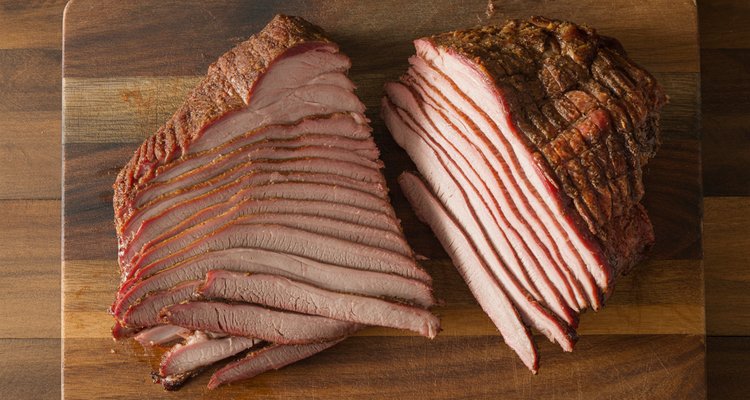
Muscle fibers in beef brisket run in parallel lines – that’s the grain. When you cut against the grain, your knife shortens those fibers into tiny segments that fall apart easily in your mouth. Cut with the grain, and you get long, intact fibers that feel stringy and tough. Here’s where brisket gets tricky. The flat’s grain runs in one direction, but the point’s grain runs roughly perpendicular to it. Slice the entire brisket in one direction and half your cuts will be with the grain. That’s why separating and rotating is essential.
Tools You Need to Slice Brisket
Best Knife for Slicing Brisket
You want a long, thin blade that glides through smoked meat in a single stroke rather than sawing back and forth. For detailed recommendations, see our guide to the best brisket knives.
- 12-14 inch slicing knife – the gold standard for brisket; a Granton edge (scalloped dimples) reduces sticking
- Serrated slicing knife – grips bark better but can tear delicate meat if you’re not careful
- Electric knife – fast for high-volume slicing but sacrifices control for uniform thickness
Cutting Board and Accessories
You’ll also need a few essentials to make slicing easier and safer:
- Large cutting board – at least 24×18 inches to fit a whole packer with room to work
- Heat-resistant gloves – brisket is still hot when you slice it, and bare hands won’t cut it
- Towels – tuck one under your board to prevent sliding
- Sheet pan – place sliced brisket on a warm pan to keep it from cooling too fast
 Helpful Gear:
- Cutluxe butcher knife — handles trimming and slicing jobs cleanly
- Empune extra-large cutting board — gives large cuts enough room for prep or slicing
- Grill Armor extra-long heat-resistant gloves — protects your hands around hot grates, pans, and smoker parts
- Bryco Goods pink butcher paper — helps hold brisket during resting and slicing prep
Step-by-Step: How to Cut a Whole Packer Brisket
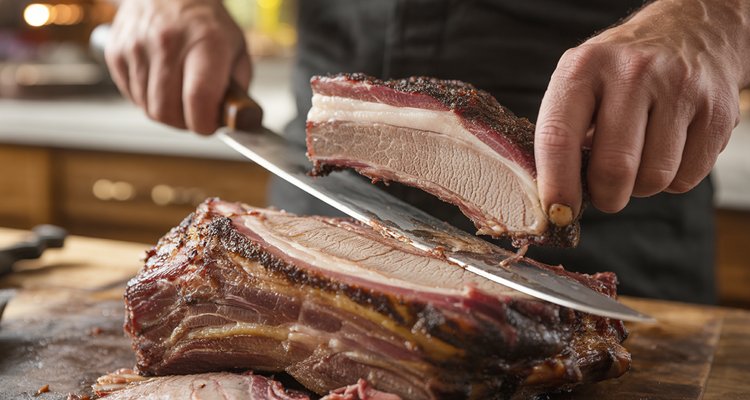
Follow these six steps for clean, tender slices from a whole packer brisket.
Step 1: Rest the Brisket
Resting is non-negotiable. Cutting immediately lets the pressurized juices pour out onto the board instead of staying in the meat.
- Rest for a minimum of 30-60 minutes before slicing
- Wrap in butcher paper or a clean towel and place in a dry cooler for longer holds
- Target an internal temperature of 170-180°F at slicing time
Step 2: Identify the Flat and the Point
Before you make a single cut, understand what you’re working with:
- The flat – the leaner, thinner, rectangular section that makes up most of the brisket’s length
- The point – the thicker, fattier section that sits on top of one end of the flat
- The fat seam – a layer of rendered fat between the two muscles where they overlap
Run your fingers along the top of the brisket to feel where the point rises above the flat. That transition zone is where you’ll separate the two.
Step 3: Find the Grain Direction
On a raw brisket, the grain is easy to see. On a cooked brisket with heavy bark, try these methods:
- Gently pull apart a small section of meat and watch how the fibers separate
- Look at the ends of the flat where the grain is often visible through the bark
- Cut a small corner off before cooking to mark the grain direction – a classic pitmaster trick
Step 4: Separate the Point from the Flat
With your brisket fat-side down, locate the fat seam between the flat and the point. Slide your knife into the seam and follow it, lifting the flat with your non-cutting hand.
- Keep the knife angled slightly toward the point to avoid cutting into the lean flat
- The fat seam should guide your blade – don’t force it through muscle
- Once separated, set the point aside while you slice the flat first
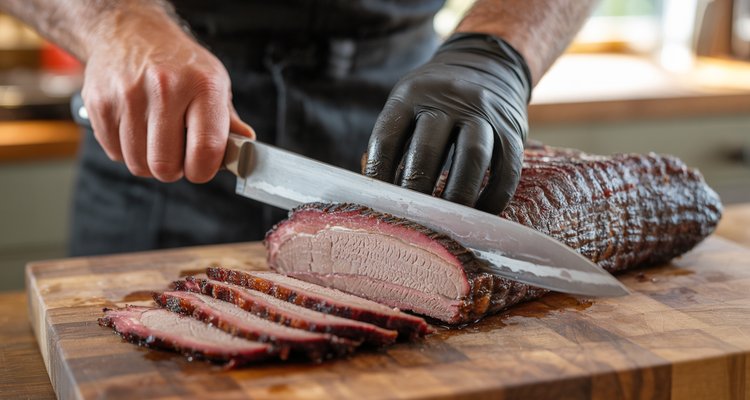
Step 5: Slice the Flat Against the Grain
Position your knife perpendicular to the grain lines. Use long, smooth strokes – let the blade do the work.
- Aim for pencil-width slices, roughly 1/4 inch thick
- Cut in a single fluid motion from one side to the other
- Keep your slices uniform for even serving portions
The bend test: Drape a slice over your index finger. A perfect slice bends under its own weight without falling apart. If it breaks in half, it’s too thin. If it stands stiff, it’s too thick or cut with the grain.
Step 6: Rotate and Slice the Point
This is the Texas Turn. The point’s grain runs roughly 90 degrees from the flat, so you need to rotate it before slicing.
- Turn the separated point 90 degrees on your cutting board
- Slice against the new grain direction
- Cut slightly thicker slices – about 3/8 inch – because the extra marbling holds them together
- Save the fatty end pieces for burnt ends – cube them into 1-inch pieces
Pitmaster Tip: Use the bend test to check your slices. If a slice flops like a wet noodle, it’s too thin. If it stands stiff, it’s too thick or cut with the grain. A perfect slice drapes gently over your finger and holds together.How to Slice a Brisket Flat Only
Slicing a standalone flat is simpler because the grain runs in one direction. No separation or rotation needed.
- Rest the flat for 30-60 minutes, same as a whole packer
- Trim any excess surface fat that didn’t render during cooking
- Identify the grain and slice perpendicular to it at 1/4-inch thickness
- Start slicing from the thinner end and work toward the thicker end
Because the flat is leaner, precise slicing matters even more. Cutting with the grain will make it tough regardless of how well you cooked it.
How to Slice a Brisket Point Only
The point is the fattier, more marbled section of the brisket. Its higher fat content gives you more flexibility with how you serve it.
- Sliced – cut slightly thicker (3/8 inch) against the grain; the extra marbling keeps slices moist
- Chopped – rough-chop for sandwiches or tacos; the fat distributes beautifully when chopped
- Burnt ends – cube into 1-inch pieces, toss with sauce, and return to the smoker at 275°F for 1-2 hours
The point’s grain can be trickier to read because of heavy marbling, so pull a small piece apart to confirm fiber direction before your first slice.
Slicing Brisket for Leftovers
The golden rule: only slice what you’ll eat right now. Unsliced brisket retains moisture far better than pre-sliced meat.
- Store unsliced portions wrapped tightly in butcher paper, then foil
- Refrigerate for up to 4 days or freeze for up to 3 months
- Best reheating method: vacuum-seal unsliced portions and submerge in a 160°F water bath for 45-60 minutes, then slice fresh
For already-sliced leftovers, vacuum seal or wrap tightly in foil with collected juices and reheat gently.
Brisket Slice Thickness Guide
| Cut | Thickness | Visual Reference | Best For |
|---|---|---|---|
| Flat slices | 1/4 inch | Pencil width | Plated servings, competition |
| Point slices | 3/8 inch | Slightly thicker than a pencil | Platters, family-style serving |
| Burnt ends | 1-inch cubes | Dice-sized chunks | Appetizers, snacking |
| Chopped brisket | Rough chop | Irregular pieces | Sandwiches, tacos, nachos |
| Sandwich slices | 1/4-3/8 inch | Standard deli thickness | Brisket sandwiches, sliders |
Mistakes That Dry Out Brisket After the Cook
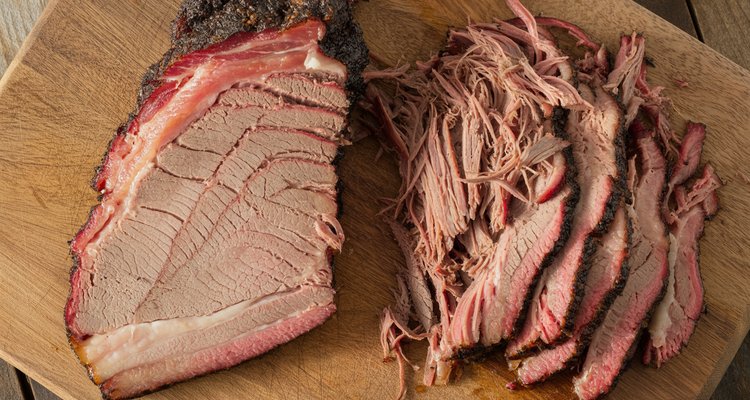
You can smoke a brisket perfectly and still ruin it on the cutting board. These are the most common slicing mistakes.
Pro Tip: Most “dry brisket” complaints aren’t cooking problems – they’re slicing problems. Before blaming your smoker, check whether you’re making one of these five mistakes at the cutting board.Cutting With the Grain
This is the number one mistake. Slicing with the grain leaves long, intact muscle fibers that require excessive chewing. Always cut perpendicular to the grain – especially after rotating the point.
Slicing Too Thin or Too Thick
Slices thinner than 1/4 inch dry out almost instantly because they have no mass to retain moisture. Slices thicker than 1/2 inch feel chewy and heavy. Use the pencil-width benchmark for the flat and go slightly thicker for the point.
Skipping the Rest
Cutting into a brisket straight off the smoker causes massive juice loss. Even 15 minutes of resting helps, but 30-60 minutes is ideal for redistribution.
Pre-Slicing the Entire Brisket
Slicing everything at once exposes maximum surface area, accelerating moisture loss. Only slice what your guests will eat in the next 10-15 minutes.
Using a Dull or Wrong Knife
A dull knife forces you to saw through the meat, tearing fibers and squeezing out juices. Use a sharp 12-14 inch slicing knife and let the blade do the work in a single stroke.
Frequently Asked Questions
How Thick Should Brisket Slices Be?
Flat slices should be about 1/4 inch thick – roughly pencil width. Point slices can go slightly thicker at 3/8 inch because the extra marbling holds them together. For burnt ends, cut 1-inch cubes. Use the bend test to confirm thickness.
Do I Cut Brisket Before or After Resting?
Always cut after resting. Your brisket needs at least 30-60 minutes after coming off the smoker for juices to redistribute. Cutting too early causes those juices to run out onto the board instead of staying in the meat.
Should I Separate the Point from the Flat Before Slicing?
Yes. The two muscles have different grain directions, so slicing them as one piece means half your slices will be cut with the grain. Separate at the fat seam, then slice each piece individually against its own grain.
What Is the Texas Turn?
The Texas Turn means rotating the brisket point 90 degrees after separating it from the flat. The point’s grain runs perpendicular to the flat’s, so you must turn it before slicing to cut against the grain on both pieces.
How Do I Find the Grain on a Cooked Brisket?
Heavy bark can hide the grain on a cooked brisket. Gently pull apart a small section of meat to see how the fibers separate – they’ll pull apart along the grain lines. You can also check the exposed ends of the flat or cut a small corner off before cooking to mark direction.
What Knife Is Best for Slicing Brisket?
A 12-14 inch slicing knife with a Granton edge is ideal. The long blade lets you cut through the flat in a single stroke, and the scalloped dimples prevent sticking. Avoid short chef’s knives – they force multiple strokes that tear fibers.
Can I Slice Brisket Ahead of Time?
You can, but it’s not ideal. Pre-sliced brisket dries out faster because exposed surface area loses moisture. If you must slice ahead, arrange slices tightly in a foil pan, pour collected juices over them, cover with foil, and hold at 150-170°F.
How Do I Store Sliced Brisket Leftovers?
Vacuum seal sliced leftovers or wrap tightly in foil with collected juices. Refrigerate for up to 4 days or freeze for up to 3 months. For best results, store brisket unsliced and reheat vacuum-sealed portions in a 160°F water bath before slicing.
Why Is My Brisket Tough Even Though I Smoked It Right?
If your brisket reached 200-205°F internally but still feels tough, the problem is almost certainly slicing-related. Cutting with the grain is the most common culprit – double-check grain direction, especially on the point. Insufficient resting time is the second most likely cause.
Can I Cut a Whole Brisket in Half Before Cooking?
Yes, you can separate the flat from the point before cooking. This helps if your smoker is too small for a whole packer or you want to cook each piece independently. The flat finishes faster, while the point benefits from a longer cook to render its extra fat. Each piece still needs slicing against its own grain.