You just finished cooking smash burgers and the griddle is caked in grease, charred bits, and sticky residue. Knowing how to clean a Blackstone griddle the right way keeps that cooking surface performing like new. This guide covers every scenario from quick after-cook wipedowns to full rust recovery and re-seasoning.
Helpful gear for this cook:
- Temperature control: ThermoMaven bristle-free grill brush cleans grates without leaving wire bristles behind.
- Handling: TrendPlain glass oil sprayer applies a thin, even coat of cooking oil.
- Prep: Hotec stainless kitchen tongs turns food cleanly without piercing it.
Essential Tools for Blackstone Griddle Cleaning
Before you start any Blackstone griddle cleaning routine, gather these supplies. Having everything within arm’s reach makes the process faster and prevents the griddle from cooling too much between steps.
- Metal scraper or spatula – your primary tool for removing food debris
- Squirt bottle with water – controlled moisture for loosening stuck-on residue
- Paper towels or microfiber cloths – for wiping and drying the surface
- Griddle stone or pumice brick – for deep cleaning and rust removal
- High smoke point oil – for re-seasoning after cleaning (avocado, flaxseed, or canola)
- Steel wool – reserved for heavy rust removal only
- White vinegar – for dissolving stubborn rust deposits
- Heat-resistant gloves – protect your hands during hot surface work
| Tool | When to Use | Notes |
|---|---|---|
| Metal Scraper | After every cook | Use while griddle is warm, not blazing hot |
| Squirt Bottle | After every cook | Small amounts only – never flood a hot surface |
| Griddle Stone | Deep cleans every 6-8 weeks | Circular motions with moderate pressure |
| Steel Wool | Heavy rust removal only | Strips seasoning – must re-season after use |
| White Vinegar | Stubborn rust deposits | Max 5 minutes contact time – attacks bare metal |
| Seasoning Oil | After every cleaning session | Thin coat only – excess causes sticky buildup |
How to Clean a New Blackstone Griddle (First Clean)
Your brand-new Blackstone griddle ships with a factory coating that protects the cold-rolled steel during transit. You need to remove this coating before your first cook. This is the one time soap and water are fully appropriate. Wash the entire cooking surface with warm water and a few drops of mild dish soap. Use a non-abrasive sponge or cloth to scrub the surface thoroughly. Rinse with clean water and dry completely with paper towels. Once the surface is bare and dry, you’re ready for your initial seasoning. Apply a thin coat of high smoke point oil, heat the griddle until the oil smokes and turns the surface dark, then repeat this process 3-4 times. Each layer builds the nonstick polymerized coating that protects the steel.
How to Clean a Blackstone Griddle After Cooking
This is the cleaning routine you’ll follow after every single cook. It takes about 5-10 minutes and keeps your Blackstone griddle seasoning in top condition. Consistency here prevents the need for deep cleans later.
Step 1 – Scrape While Warm
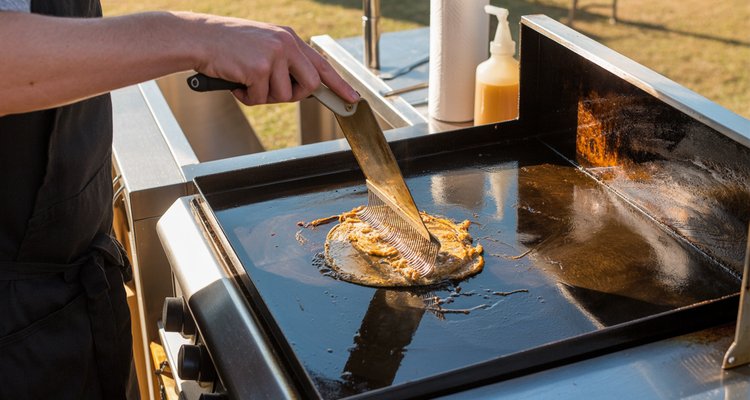
Turn off the burners as soon as you’re done cooking. While the surface is still warm, use your metal scraper to push food scraps, grease, and charred bits toward the grease trap. Work in long, firm strokes across the entire surface. Don’t wait until the griddle cools completely. Warm residue lifts easily. Cold residue bonds to the surface and becomes much harder to remove.
Step 2 – Squirt Water to Loosen Residue
For stubborn spots, squeeze a small amount of warm water from your squirt bottle directly onto the problem area. The steam action loosens baked-on grease and food particles. Use only a few tablespoons at a time. Blackstone recommends a squirt bottle over pouring because controlled amounts prevent thermal shock to the steel surface.
Step 3 – Scrape Again and Wipe Clean
Scrape the loosened debris toward the grease trap. Repeat the water-and-scrape cycle two or three times until the surface looks clean. Wipe with paper towels to remove any remaining moisture and residue.
Step 4 – Dry the Surface Completely
This Blackstone griddle cleaning step is critical for rust prevention. Use a clean microfiber cloth or paper towels to dry every inch of the cooking surface. Pay attention to the edges, corners, and side walls where moisture collects. Any water left on bare steel invites rust. Even a few drops in a corner can create orange spots on your Blackstone griddle overnight.
Step 5 – Apply a Thin Coat of Oil
Pour about two tablespoons of high smoke point oil onto the griddle. Spread it evenly across the entire surface using a folded paper towel. Cover the corners, edges, and side walls. This thin oil layer serves two purposes. It maintains your Blackstone griddle seasoning and creates a moisture barrier that prevents rust between cooks. A thin coat is all you need. Too much oil causes the sticky buildup that frustrates many Blackstone griddle owners.
How to Deep Clean a Blackstone Griddle
Even with consistent after-cook Blackstone griddle cleaning, your griddle needs a deeper clean every 6-8 weeks. Deep cleaning removes carbonized oil buildup, restores the surface texture, and gives you a fresh foundation for new Blackstone griddle seasoning layers. You should also deep clean your Blackstone griddle after extended storage, if you notice food sticking more than usual, or if the surface has developed an uneven, flaky appearance.
When Soap Is and Isn’t Appropriate
This is the most debated topic in Blackstone griddle cleaning and maintenance. Here’s the straightforward answer based on manufacturer guidance. Soap is appropriate for:
- First-time cleaning of a new griddle (removing factory coating)
- Deep cleans where you plan to fully re-season afterward
- Removing rancid oil smell from a neglected griddle
Soap is NOT appropriate for:
- Routine after-cook cleaning (strips the seasoning layer)
- Quick touch-ups between meals
- Any cleaning where you won’t re-season immediately after
The reason is simple. Dish soap is designed to cut through oil. Your Blackstone griddle seasoning IS oil, polymerized into a protective coating. Using soap during routine Blackstone cleaning dissolves that coating and leaves your steel surface exposed to moisture and food adhesion.
Using a Griddle Stone for Deep Cleaning
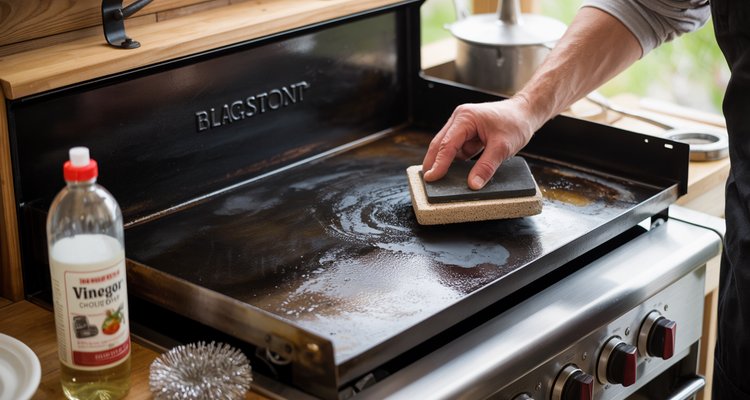
A griddle stone (pumice brick) is your best Blackstone cleaning tool for deep cleaning without chemicals. Heat the Blackstone griddle slightly to warm the surface, then apply a small amount of oil. Work the griddle stone in circular motions with moderate, consistent pressure. The stone’s abrasive surface lifts carbonized buildup without gouging the steel underneath. Continue until the surface looks uniformly clean. Wipe away the loosened residue with paper towels. You may need several rounds of scrubbing and wiping before the paper towels come away clean. Once they do, dry the entire surface thoroughly.
Re-Seasoning After a Deep Clean
After any deep clean, you must rebuild the Blackstone griddle seasoning layer before cooking again. The process is identical to seasoning a new Blackstone griddle.
- Apply a very thin coat of high smoke point oil across the entire surface
- Turn all burners to high heat
- Let the oil smoke and darken until it stops smoking (about 10-15 minutes)
- Turn off the heat and let the griddle cool slightly
- Repeat 3-4 times for a durable nonstick coating
Each coat should be thin enough that you can barely see it. Thick oil pools during heating and create sticky, uneven patches instead of smooth seasoning.
How to Remove Rust from a Blackstone Griddle
Rust forms when moisture contacts unprotected steel. If you forgot to oil your griddle after cleaning, left it uncovered in humid weather, or stored it for the winter without proper preparation, you’ll likely find orange spots on the cooking surface. The good news is that rust on a Blackstone griddle is almost always recoverable. The approach depends on severity.
Light Rust Removal
Light rust appears as scattered orange spots or a thin orange film across the surface. This is the most common scenario and the easiest to fix.
- Heat the griddle on high for about 20 minutes to loosen the rust
- Turn off the heat and let it cool enough to work safely
- Scrape the surface with your metal scraper to remove loose rust and debris
- Apply 2-4 tablespoons of oil and scrub with a griddle stone using firm, circular motions
- Wipe clean with paper towels and repeat until no orange residue appears
- Re-season with 3-4 thin oil coats as described above
Heavy Rust Removal with Vinegar
Heavy rust covers large areas of the surface with thick, textured orange deposits. A griddle stone alone won’t cut through it. This is where white vinegar becomes essential.
- Spray white vinegar directly onto the rusted areas
- Wait exactly 5 minutes – no longer
- Scrub aggressively with fine-grade steel wool or a pumice stone
- Spray warm water immediately to rinse away the vinegar and dissolved rust
- Wipe clean with paper towels
- Repeat on any remaining rust patches
- Dry the entire surface thoroughly
- Re-season with 4-5 thin oil coats to rebuild full protection
| Severity | Method | Tools | Time | Re-Seasoning |
|---|---|---|---|---|
| Light (scattered spots) | Heat + oil + scrub | Griddle stone, scraper | 30-45 minutes | 3-4 coats |
| Moderate (large patches) | Heat + vinegar + scrub | Steel wool, griddle stone | 45-60 minutes | 4-5 coats |
| Heavy (full surface) | Vinegar soak + aggressive scrub | Steel wool, sandpaper, griddle stone | 1-2 hours | 5-6 coats |
How to Season a Blackstone Griddle After Cleaning
Griddle seasoning is what transforms raw steel into a nonstick cooking surface. Every time you strip Blackstone griddle seasoning through deep cleaning or rust removal, you need to rebuild it. Even routine after-cook griddle cleaning should end with a light oil application. The best oils for Blackstone griddle seasoning have high smoke points and low saturated fat content. These properties allow the oil to polymerize into a hard, durable coating on your Blackstone griddle rather than remaining as a sticky residue.
| Oil Type | Smoke Point | Best For |
|---|---|---|
| Flaxseed Oil | 225°F | Hardest seasoning layer, but can flake if applied too thick |
| Canola Oil | 400°F | Everyday seasoning, widely available, good all-around choice |
| Avocado Oil | 520°F | High-heat cooking, excellent durability |
| Vegetable Oil | 400-450°F | Budget-friendly option, solid seasoning performance |
| Grapeseed Oil | 420°F | Neutral flavor, clean seasoning finish |
| Blackstone Seasoning Conditioner | Varies | Convenient, formulated specifically for griddle seasoning |
The seasoning process itself is straightforward:
- Start with a clean, dry griddle surface
- Apply a paper-thin layer of oil using a folded paper towel
- Turn all burners to high
- Wait until the oil smokes and the surface darkens (10-15 minutes)
- Turn off burners and let the griddle cool slightly
- Repeat 3-4 times for initial seasoning, or 1-2 times for post-cook maintenance
The key mistake most people make is applying too much oil. If you can see pools or runs of oil on the surface, you’ve used too much. Wipe away the excess before heating.
How to Store Your Blackstone Griddle
Proper storage is the easiest way to prevent rust and protect your Blackstone griddle seasoning between cooks. A few minutes of Blackstone cleaning preparation saves hours of rust removal later. Before storing, always:
- Complete the full after-cook cleaning routine
- Apply a generous coat of oil to the entire cooking surface
- Cover the griddle with a fitted heavy-duty canvas cover
Best storage locations (in order of preference):
- Inside a garage or shed (protected from rain and humidity)
- Under a covered patio with a fitted griddle cover
- Outdoors with a high-quality weather-resistant cover (least ideal)
If you don’t cook on your griddle every week, check the surface at least once a month. Catching rust early when it’s just a few spots is far easier than restoring a fully corroded surface.
Blackstone Griddle Troubleshooting Guide
Even experienced Blackstone griddle owners run into surface issues. Here are the four most common Blackstone griddle cleaning problems and exactly how to fix each one.
Peeling or Flaking Seasoning
What it looks like: Black flakes peeling off the surface, exposing lighter metal underneath. Cause: Oil was applied too thick during seasoning, or the initial seasoning wasn’t heated long enough to fully polymerize. The thick patches never bonded properly to the steel. Fix: Strip the affected area (or the entire surface) back to bare metal using a griddle stone or steel wool. Then re-season from scratch with very thin oil coats. Each coat should be barely visible before you heat it.
Sticky or Tacky Surface
What it looks like: The surface feels sticky or gummy to the touch, and food sticks more than it should. Cause: Too much oil was applied during the last seasoning, and it didn’t fully polymerize. The oil remained as a semi-dried sticky layer instead of converting into a hard coating. Fix: Turn all burners to high and let the griddle heat until the stickiness burns off and the smoking stops (15-20 minutes). Wipe with a paper towel while still warm. If the stickiness persists, scrub with a griddle stone, wipe clean, and re-season with thinner oil coats.
Orange Rust Spots
What it looks like: Orange or reddish-brown spots or patches on the cooking surface. Cause: Moisture reached unprotected steel. This happens when the griddle wasn’t oiled after cleaning, was stored without a cover, or was left out in rain or high humidity. Fix: Follow the rust removal steps in the section above. Light rust needs only a griddle stone and oil. Heavy rust requires vinegar and steel wool. Always re-season after any rust removal.
Rancid Oil Smell
What it looks like: The griddle produces an unpleasant, stale, or rancid odor when heated. Cause: Old cooking oil was left on the surface without being properly cleaned or re-seasoned. The oil oxidized and went rancid over time, especially in warm storage conditions. Fix: Perform a full deep clean with warm soapy water (this is one of the rare times soap is called for). Scrub the entire surface with a griddle stone to remove all traces of the old oil. Rinse thoroughly, dry completely, and re-season with fresh oil using 4-5 coats.
Common Blackstone Cleaning Mistakes to Avoid
These are the errors that cause the most damage to Blackstone griddles. Avoiding them will keep your cooking surface in great shape for years.
- Using soap after every cook – soap strips the seasoning layer that took multiple cooks to build
- Cleaning a cold griddle – cold residue bonds to the surface and requires much more scrubbing force, which damages seasoning
- Pouring cold water on a hot griddle – thermal shock can warp the cooking surface permanently
- Over-scraping the seasoning – slight darkening and discoloration is normal and desirable, not damage
- Storing without an oil coating – bare steel rusts quickly, especially in humid climates
- Applying too much seasoning oil – thick coats create sticky, gummy patches instead of smooth nonstick seasoning
- Skipping the drying step – even small amounts of water left on the surface can cause rust spots overnight
Frequently Asked Questions
Can I Use Soap on My Blackstone Griddle?
Yes, but only in specific situations. Soap is safe for the initial Blackstone cleaning of a new griddle and during deep cleans where you plan to fully re-season afterward. For routine after-cook Blackstone griddle cleaning, skip the soap entirely. Hot water, a metal scraper, and a light oil coat are all you need. Soap strips the polymerized oil layer that gives your griddle its nonstick performance.
How Do I Remove Rust from a Blackstone Griddle?
For light rust, heat the griddle on high for 20 minutes, scrape the loose rust, then scrub with oil and a griddle stone. For heavy rust, spray white vinegar on the affected areas, wait 5 minutes, and scrub with steel wool. Rinse the vinegar off promptly with warm water. After removing all rust, dry the surface completely and re-season with 3-5 thin oil coats.
Do I Have to Season After Every Cook?
You don’t need to do a full multi-coat Blackstone griddle seasoning after every cook. However, you should apply a thin coat of oil as the final step of your after-cook griddle cleaning routine. This maintains the existing seasoning and prevents rust. Full re-seasoning (3-5 coats) is only necessary after deep cleans, rust removal, or when food starts sticking noticeably.
Can I Use a Wire Brush on My Blackstone?
Wire brushes are not recommended for Blackstone griddles. The bristles can scratch the flat surface unevenly and damage the seasoning layer. More importantly, loose bristles can break off and end up in your food. Use a metal scraper or griddle stone instead. These tools clean effectively without the safety risk.
How Often Should I Deep Clean My Blackstone Griddle?
Deep clean your Blackstone griddle every 6-8 weeks with regular use. If you cook on it less frequently, schedule Blackstone griddle cleaning every 8-10 weeks. You should also deep clean if food starts sticking more than usual, the seasoning looks flaky or uneven, or you notice a rancid smell when heating the griddle.
What Oil Is Best for Seasoning a Blackstone Griddle?
Canola oil and avocado oil are the most popular choices for Blackstone griddle seasoning among experienced griddle owners. Canola oil is affordable, widely available, and creates a solid seasoning layer. Avocado oil has a higher smoke point and produces a more durable coating but costs more. Flaxseed oil creates the hardest seasoning but tends to flake if applied too thickly. Avoid butter, olive oil, and coconut oil for seasoning as their low smoke points produce poor results.
Why Is My Blackstone Griddle Sticky After Seasoning?
A sticky Blackstone griddle surface almost always means too much oil was applied during griddle seasoning. The excess oil didn’t fully polymerize and remained as a gummy residue. Fix it by heating the griddle on high until the stickiness burns off. For stubborn stickiness, scrub with a griddle stone, wipe clean, and re-season using thinner coats. The oil layer should be nearly invisible before you heat it.
Can I Use Steel Wool on a Blackstone Griddle?
Steel wool should only be used for heavy rust removal. It’s too abrasive for routine cleaning and will strip your seasoning layer completely. After using steel wool, you must re-season the griddle with at least 4-5 coats of oil. For everyday cleaning, stick with a metal scraper and paper towels. For deep cleaning, a griddle stone provides enough abrasion without the aggressive stripping.
How Do I Clean a Blackstone Griddle After Winter Storage?
Start by removing the cover and inspecting the Blackstone griddle surface for rust. If you find rust, follow the appropriate removal steps based on severity. If the surface is rust-free but looks dull or has old oil residue, heat the griddle on high for 15-20 minutes to burn off any contaminants. Scrape and wipe clean, then re-season with 2-3 coats of fresh oil before your first cook of the season.
Is It OK to Use Water on a Blackstone Griddle?
Yes, water is safe and recommended for loosening stubborn food debris during after-cook cleaning. The key is to use small amounts from a squirt bottle rather than pouring large quantities directly on the surface. Always use warm water on a warm (not blazing hot) griddle to avoid thermal shock. After using water, dry the surface completely and apply oil to prevent rust.
Keep Your Griddle Cooking Like New
Blackstone griddle cleaning isn’t complicated once you understand the three tiers of care. After every cook, scrape, wipe, and oil. Every 6-8 weeks, deep clean with a griddle stone and re-season. If rust appears, tackle it with heat, vinegar, and fresh seasoning coats. Consistency matters more than perfection. A quick 5-minute cleanup after each cook prevents 90% of the problems that lead to deep cleans and rust removal. Pair that routine with proper storage and a fitted cover, and your Blackstone griddle will deliver perfectly seared smash burgers and breakfast spreads for years to come. For more on getting the most from your flat top, check out our guide to the best Blackstone accessories that make cooking and cleaning even easier.