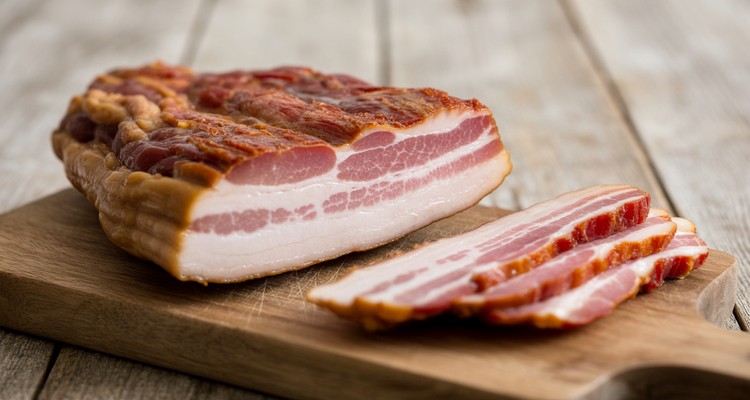
Pork jowl bacon is one of the richest, most intensely flavored bacons you can make at home. It comes from the cheek of the pig, a cut with a high fat-to-meat ratio that cures and smokes into something silky, deeply savory, and unlike anything from a grocery store package.
This guide walks you through every step of a complete pork jowl bacon recipe — from selecting the cut and building a safe equilibrium cure to forming a pellicle, smoking to temperature, and properly slicing the bacon for storage. You’ll also find cooking ideas, a full FAQ section, and a timeline table to keep the process clear.
Quick Summary
- Rich Flavor: Pork jowl bacon, made from the pig’s cheek, boasts a higher fat content than belly bacon, resulting in a silkier texture and a more concentrated, deeply savory pork flavor.
- Safety First: This recipe uses an equilibrium cure with precisely weighed kosher salt, brown sugar, and Prague Powder #1 (curing salt) to prevent bacterial growth during the low-temperature smoking process.
- Key Takeaway: Step-by-Step Process – The guide covers everything from preparing the jowl and applying the cure (5-7 days) to forming a pellicle, smoking to an internal temperature of 150°F, chilling, and slicing for optimal texture and storage.
- Versatile Use: Once smoked and sliced, jowl bacon can be pan-fried or oven-baked until crispy, perfect for breakfast, flavoring greens and beans, or enhancing sandwiches and salads.
What Is Pork Jowl Bacon?
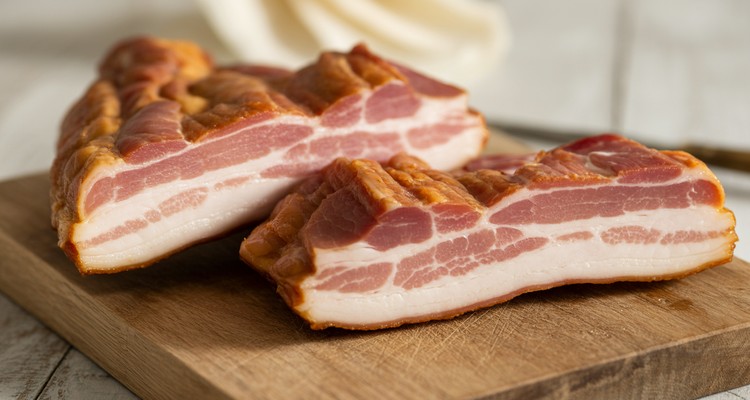
Pork jowl bacon is cured and smoked meat made from the cheek muscle of the pig. It has a higher fat content than belly bacon, which gives it a richer texture and a more concentrated pork flavor after curing and smoking.
Pork Jowl vs. Belly Bacon
Traditional belly bacon comes from the underside of the pig. Jowl bacon comes from the cheek, a harder-working muscle with more intramuscular fat running through it.
That extra fat means jowl bacon renders beautifully in the pan. The finished product is richer, more tender, and has a deeper pork flavor than standard belly slices.
Is Jowl Bacon the Same as Guanciale?
Both jowl bacon and guanciale come from the pork cheek, but they are prepared very differently. Guanciale is cured with salt and spices, then air-dried for several weeks without smoking. It is not cooked before it reaches the table — it is a raw, dry-cured product used in Italian pasta dishes like carbonara and amatriciana.
Jowl bacon takes a different path. It is cured with salt, sugar, and curing salt, then smoked low and slow until it reaches a safe internal temperature[USDA]. It is cooked before eating, just like American belly bacon.
The Science of Curing: Safety First
Curing converts raw pork into safe, shelf-stable bacon by drawing out moisture, inhibiting bacterial growth, and locking in flavor and color. Using the correct amount of curing salt is a critical safety step. Getting the cure right is the most important part of this entire process.
Why Curing Salt Is Essential
Curing salt — commonly sold as Prague Powder #1 or pink curing salt — contains sodium nitrite, which prevents the growth of Clostridium botulinum during the low-temperature smoking process. This bacteria thrives in the warm, moist, low-oxygen environment inside a smoker, making curing salt a non-negotiable safety requirement[USDA].
Curing salt also preserves the characteristic reddish-pink color of the meat and contributes to the familiar cured bacon flavor. Do not substitute it with table salt or sea salt.
Calculating Your Cure
Equilibrium curing (EQ curing) is the safest and most consistent method for home bacon making. Instead of submerging the meat in a brine, you apply a precisely weighed amount of cure directly to the meat. The meat absorbs exactly what it needs — no more, no less.
A reliable starting formula is 2.5% kosher salt, 1% brown sugar, and 0.25% Prague Powder #1, all calculated by the weight of the meat. Use a digital kitchen scale for every measurement.
The salt and sugar ratios can be adjusted slightly to taste, but the 0.25% Prague Powder #1 ratio is a critical safety requirement that should never be reduced.
For a 4 lb (1,814 g) pork jowl, this works out to approximately 45 g kosher salt, 18 g brown sugar, and 4.5 g Prague Powder #1.
 Pitmaster Tip: Always use non-iodized salt such as kosher salt for curing. Iodine can interfere with the curing process and sometimes imparts off-flavors to the finished bacon.
Step-by-Step Pork Jowl Bacon Recipe
This recipe covers a 3-5 lb skinless pork jowl, a process that is straightforward but requires patience. If your jowl has skin attached, ask your butcher to remove it or trim it off with a sharp knife before you begin.
Helpful gear for this cook:
- ThermoMaven wireless meat thermometer — tracks long cooks without opening the smoker
- Hotec stainless steel kitchen tongs — make turning and moving food easier
- Spice Guru BBQ rub set — gives you several BBQ seasoning options for the cook
Equipment You Will Need
Having the right tools makes the curing and smoking process safer and more consistent. You do not need specialized equipment beyond a digital scale and a reliable thermometer.
- Digital kitchen scale (measures in grams)
- Large zip-top bag or non-reactive container (glass, stainless steel, or food-grade plastic)
- Wire rack and rimmed baking sheet
- Smoker or grill set up for indirect cooking
- Instant-read digital meat thermometer
- Wood chunks or chips (hickory, apple, cherry, or maple)
- Sharp slicing knife or meat slicer
Ingredients
- 3-5 lb skinless pork jowl
- Kosher salt (non-iodized) — 2.5% of meat weight
- Brown sugar or maple sugar — 1% of meat weight
- Prague Powder #1 (curing salt) — 0.25% of meat weight
- Coarsely ground black pepper — to taste
- Optional: paprika, garlic powder, cayenne
The Curing Process: Patience Is Key
Equilibrium curing takes 5-7 days in the refrigerator. The process is mostly hands-off — you flip the bag once a day and let the cure do its work. Rushing the cure by cutting this time short is a food safety risk, not just a flavor issue.
Step 1: Prepare and Apply the Cure
Pat the pork jowl completely dry with paper towels. Trim any loose flaps of fat or skin around the edges if needed. Weigh the jowl, then calculate and weigh each cure ingredient using your digital scale.
Combine the kosher salt, brown sugar, Prague Powder #1, black pepper, and any optional spices in a small bowl. Rub the mixture evenly over all surfaces of the jowl, pressing it into any crevices to ensure full coverage.
Step 2: Refrigerate and Overhaul
Place the cure-coated jowl into a large zip-top bag and press out as much air as possible. Seal it and place it flat in the refrigerator on a rimmed tray to catch any leaks. Refrigerate for 5-7 days.
Flip the bag once per day to redistribute the liquid (brine) that accumulates inside. This step is called overhauling. The jowl will feel progressively firmer as the cure works through the meat.
Pro Tip: Write the start date on the zip-top bag with a marker so you don’t lose track of where you are in the curing window. A 5-day cure is safe; a 7-day cure gives you a bit more flexibility if life gets busy.Step 3: Rinse, Dry, and Form a Pellicle
After the curing period, remove the jowl from the bag and rinse it thoroughly under cold running water. You want to wash away all surface cure — this prevents the finished bacon from being overly salty.
Pat the jowl completely dry with paper towels. Set it on a wire rack over a baking sheet and return it to the refrigerator, uncovered, for 12-24 hours. During this rest, the surface of the meat dries and develops a tacky film called a pellicle.
The pellicle is what allows smoke particles to bond to the meat during cooking.
Smoking Your Cured Pork Jowl
Once the pellicle has formed, the jowl is ready for the smoker. The goal here is low, gentle heat that slowly brings the internal temperature to a safe, fully cooked endpoint while layering on smoke flavor.
Smoker Setup and Wood Choice
Preheat your smoker to 200-225°F. Maintaining a steady low temperature is important — spiking much higher can cause the fat to render out too quickly before the smoke flavor has a chance to penetrate.
Hickory smoke is the classic choice for bacon and gives a bold, traditional flavor. Apple, cherry, and maple all produce a milder, slightly sweeter smoke that complements the rich fat of the jowl. Avoid mesquite for bacon — it is too aggressive for this long a cook.
Smoking to the Target Internal Temperature
Place the pellicle-formed jowl directly on the smoker grate, fat side up. Insert a probe thermometer into the thickest part of the meat. Smoke at 200-225°F until the internal temperature reaches 150°F[USDA].
Depending on smoker temperature and the thickness of your jowl, this typically takes 2-4 hours. Temperature is always the indicator of doneness — not time. A thicker jowl or a smoker running on the cooler end of the range may take longer.
Pitmaster Tip: If your smoker runs hot and the jowl is approaching 140°F internal while still pale, add a small pan of ice water to the smoker to help moderate the chamber temperature and slow the cook.Curing and Smoking Timeline
This table summarizes every phase of the pork jowl bacon process from start to finish. Use it as a planning reference before you begin.
| Phase | Typical Duration | Temperature | Key Goal |
|---|---|---|---|
| Apply Cure | 30 minutes | Room temp | Weigh ingredients, mix cure, coat jowl evenly on all sides |
| Curing | 5-7 days | Refrigerator (34-40°F) | Flip daily; cure penetrates meat for safety and flavor |
| Rinse and Dry | 15-30 minutes active | Cold water rinse | Remove surface cure; pat dry thoroughly |
| Pellicle Formation | 12-24 hours | Refrigerator (uncovered) | Tacky surface forms so smoke adheres during cooking |
| Smoking | 2-4 hours | Smoker 200-225°F; target 150°F internal | Cook through to safe internal temp, build mahogany bark |
| Chilling | 8 hours to overnight | Refrigerator (wrapped) | Firm up the slab so it can be sliced thin and evenly |
Finishing, Slicing, and Storing Your Bacon
Once the jowl bacon hits 150°F, the hardest work is done. The final step before you get to eat anything requires a little more patience — chilling the slab so it firms up enough for clean slicing.
Chilling for the Perfect Slice
Remove the jowl from the smoker and let it rest at room temperature for about 30 minutes. Then wrap it tightly in plastic wrap or butcher paper and transfer it to the refrigerator. Chill for at least 8 hours, or overnight if you can wait.
A cold, firm slab cuts cleanly. Trying to slice thin bacon from a warm slab results in ragged, uneven pieces that tear rather than slice.
How to Slice and Store Jowl Bacon
Use a sharp slicing knife or a meat slicer to cut the bacon to your preferred thickness. Thin slices, about 1/8 inch, render and crisp quickly. Thicker slices, around 1/4 inch, hold up well in beans, soups, and braises.
For storage, wrap sliced bacon in plastic wrap and then foil, or vacuum-seal it in portions. Refrigerate for up to 2 weeks. For longer storage, freeze tightly wrapped portions for up to 3 months.
Label each package with the date.
How to Cook and Use Pork Jowl Bacon
Jowl bacon is cooked — it reached a safe internal temperature in the smoker — but it is not yet ready to eat straight from the slab. Like all cured-and-smoked bacon, it needs a final cooking step to render the fat and develop texture and flavor.
Cooking Methods
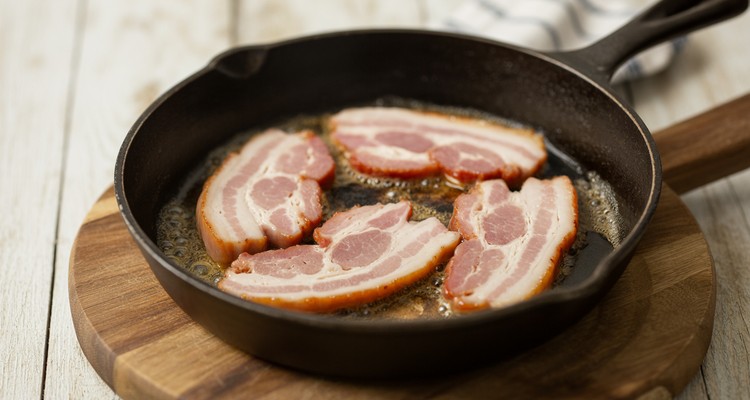
Pan-frying is the easiest and fastest method. Cook slices in a skillet over medium-low heat, turning occasionally, until the fat renders and the edges crisp. Jowl bacon renders significantly more fat than belly bacon, so start with a cold pan and go low and slow.
Oven baking works well for larger batches. Arrange slices on a wire rack set over a baking sheet and bake at 400°F for 15-20 minutes, or until they reach your preferred level of crispness.
Serving Suggestions
Jowl bacon works in almost any dish where you would use belly bacon. Its richer fat content makes it especially good in slow-cooked applications where the fat has time to fully render into the dish.
- Crispy alongside breakfast eggs, toast, or grits
- Diced and rendered to flavor collard greens, pinto beans, or split pea soup
- Layered into a BLT sandwich as the main event
- Crumbled over burgers, salads, or baked potatoes for a smoky, savory crunch
 Quick Facts: Pork jowl bacon is a rich, intensely flavored bacon made from the pig’s cheek, cured with salt, sugar, and Prague Powder #1, then smoked to an internal temperature of 150°F. It offers a deeper pork flavor and silkier texture than traditional belly bacon.
Take Home Message
The pork jowl bacon process takes patience, but the active work at each stage is simple. Apply the cure, flip the bag once a day for a week, rinse and dry, smoke to temperature, chill, and slice. No special skills are required beyond a scale and a reliable thermometer.
What you get at the end is a slab of deeply flavorful, smoky jowl bacon that outperforms anything you can buy at the grocery store. Use it for breakfast, beans, greens, BLTs, or anywhere else that calls for the real thing.
Frequently Asked Questions
Can I make pork jowl bacon without curing salt?
No. Curing salt (Prague Powder #1) is a food safety requirement for this recipe, not an optional ingredient. The low-temperature smoking process creates conditions where Clostridium botulinum can grow in improperly cured meat.
Always use the correct amount of curing salt and measure it by weight using a digital scale.
How long should pork jowl cure before smoking?
Cure for a minimum of 5 days and up to 7 days using the equilibrium method. A full 7-day cure ensures the cure has penetrated completely through the thickest part of the jowl. Do not shorten the cure period — under-cured bacon is both unsafe and unpleasant in texture.
What does pork jowl bacon taste like?
Jowl bacon has a richer, more intensely porky flavor than belly bacon. The high fat-to-meat ratio gives it a silky, almost buttery quality when cooked. When paired with hickory smoke, it develops a deep, savory flavor that is distinct from standard supermarket bacon.
What internal temperature should smoked jowl bacon reach?
Smoke jowl bacon to an internal temperature of 150°F[USDA] in the thickest part of the meat. Use an instant-read digital thermometer to check — this is not a step to estimate by time or color alone. Once it reaches 150°F, it is fully cooked and safe to eat after a final pan-fry or oven step.
My finished bacon is too salty. What went wrong?
Excessive saltiness usually comes from one of three issues. First, you may not have rinsed the surface cure off thoroughly enough after the curing period. Second, your salt calculation may have been off — always weigh ingredients with a scale, not a measuring cup.
Third, some cooks briefly soak the rinsed jowl in cold water for 30 minutes after rinsing to draw out additional surface salt before drying.
What wood is best for smoking jowl bacon?
Hickory is the classic choice for a bold, traditional bacon flavor. Apple, cherry, and maple produce a milder, slightly sweet smoke that works well with the rich fat of the jowl. Avoid mesquite — it produces a bitter, overpowering smoke on a long low-and-slow cook.
Can I smoke pork jowl bacon on a pellet grill?
Yes. Set your pellet grill to its lowest smoke setting, ideally around 180-200°F, and use hickory or apple pellets. Pellet grills produce a lighter smoke profile than offset smokers, so expect a subtler smoke flavor.
You may want to run the jowl at the lower setting for the first hour to maximize smoke uptake before allowing the temperature to rise toward 225°F to finish.
How long does homemade jowl bacon last?
Properly wrapped or vacuum-sealed, homemade jowl bacon keeps for up to 2 weeks in the refrigerator. For longer storage, freeze tightly wrapped portions for up to 3 months. Label every package with the date it was made and frozen so nothing gets lost in the back of the freezer.
Smoked Pork Jowl Bacon
Equipment
- Digital kitchen scale Essential for accurately measuring cure ingredients.
- Large zip-top bag or non-reactive container For curing the pork jowl in the refrigerator.
- Wire rack and rimmed baking sheet For forming the pellicle and catching drips.
- Smoker or grill Set up for indirect cooking at 200-225°F.
- Instant-read digital meat thermometer To monitor the internal temperature of the bacon.
- Wood chunks or chips Hickory, apple, cherry, or maple are recommended.
- Sharp slicing knife or meat slicer For slicing the finished bacon slab.
Ingredients
- 3-5 lb skinless pork jowl
For the Equilibrium Cure (by weight):
- 2.5% Kosher salt (non-iodized) of the meat's weight
- 1% Brown sugar or maple sugar of the meat's weight
- 0.25% Prague Powder #1 (curing salt) of the meat's weight - do not reduce
- Coarsely ground black pepper to taste
- Optional spices paprika, garlic powder, or cayenne to taste
Instructions
- Prepare the Cure: Pat the pork jowl completely dry. Weigh the jowl on a digital scale. Calculate and weigh the kosher salt (2.5%), brown sugar (1%), and Prague Powder #1 (0.25%) based on the jowl's weight.
- Apply the Cure: Combine the salt, sugar, Prague Powder #1, black pepper, and any optional spices in a small bowl. Rub the mixture evenly over all surfaces of the jowl, ensuring complete coverage.
- Cure in Refrigerator: Place the coated jowl in a large zip-top bag, press out the air, and seal. Place on a tray in the refrigerator for 5-7 days. Flip the bag once daily to redistribute the brine.
- Rinse and Form Pellicle: After 5-7 days, remove the jowl from the bag and rinse thoroughly under cold water to remove all surface cure. Pat completely dry with paper towels.
- Dry in Refrigerator: Place the rinsed jowl on a wire rack over a baking sheet and return to the refrigerator, uncovered, for 12-24 hours. This will form a dry, tacky surface called a pellicle.
- Preheat Smoker: Preheat your smoker or grill for indirect cooking to a stable temperature between 200-225°F. Add your choice of wood chunks or chips (hickory, apple, or cherry).
- Smoke the Jowl: Place the jowl directly on the smoker grate. Insert a meat probe into the thickest part. Smoke until the internal temperature reaches 150°F, which typically takes 2-4 hours.
- Cool and Slice: Remove the smoked jowl from the smoker and let it cool completely. For best results, chill thoroughly in the refrigerator for several hours or overnight before slicing into bacon strips with a sharp knife or meat slicer.
Notes