The best small gas grills deliver real cooking power without consuming your entire outdoor space. Whether you’re working with a compact apartment balcony, a small patio, or you need something genuinely portable for tailgating and camping, a compact propane grill gives you the performance you want in a fraction of the footprint. I’ve tested dozens of models over the past three years to bring you the top picks for 2026 — units that heat evenly, ignite reliably, and hold up season after season.
Quick Roundup List
- Best Overall: Coleman RoadTrip 285 Portable Stand-Up Propane Grill
- Best Compact Pick: Cuisinart Petite Gourmet Portable Gas Grill with VersaStand
- Best Portable: Weber Q 2800N+ Liquid Propane Portable Grill
- Best Design: Cuisinart Venture Portable Gas Grill
- Best 2-Burner Tabletop: Cuisinart Chef’s Style CGG-306 Tabletop Propane Grill
Why a Compact Gas Grill Is Worth It
Smaller outdoor cookers consistently surprise people with what they can accomplish. In my testing across everything from 150 sq in tabletop units to mid-size freestanding models, compact propane grills routinely outperform expectations — and outperform larger grills in several ways that genuinely matter to everyday cooks.
- Space-saving design: Perfect for apartments, condos, and small patios. Most models I’ve tested fit comfortably in spaces as small as 3×3 feet, and several fold down to storage size when not in use.
- True portability: Many compact grills weigh under 30 lbs, making them ideal for camping, tailgating, and beach cookouts. See our tailgating grill guide for more portable options.
- Fuel efficiency: Smaller cooking surfaces use less propane. In my testing, a standard 16.4 oz cylinder typically provides 3–4 hours of continuous cooking on most compact units.
- Fast preheat: Most small gas grills reach cooking temperature in 10–15 minutes — roughly half the time of full-size cabinet grills.
- Easy maintenance: Less surface area means less cleaning time. Pairing a small gas grill with quality grill trays makes cleanup even faster.
Product Comparison Table
| Grill | Cooking Area | BTU | Burners | Weight | Best For | Link |
|---|---|---|---|---|---|---|
| Coleman RoadTrip 285 | 285 sq in | 20,000 | 3 | 46.7 lbs | Groups, Tailgating, Versatility | See at Amazon |
| Cuisinart VersaStand | 150 sq in | 5,500 | 1 | ~17 lbs | Solo/Couple, Small Balcony | See at Amazon |
| Weber Q 2800N+ | 320 sq in | 18,000 + 4,000 | Main + Plus | 43.5 lbs | Premium Quality, Camping, Travel | See at Amazon |
| Cuisinart Venture | 154 sq in | 9,000 | 1 | 20 lbs | Design, Entertaining, Beach | See at Amazon |
| Cuisinart CGG-306 | 275 sq in | 20,000 | 2 | 22 lbs | Dual-Zone, Apartment, Patio | See at Amazon |
How to Choose the Best Small Gas Grill
With dozens of compact propane grills on the market, these are the factors that actually matter when you’re making a buying decision.
Cooking Area and BTU Efficiency
For 2–4 people, look for a cooking surface between 150–300 square inches. The key metric isn’t total BTU output — it’s BTU per square inch. Aim for 80–100 BTU per square inch of cooking surface for optimal performance. A 10,000 BTU burner delivering even coverage across 150 sq in is far more useful than a 20,000 BTU unit with severe hot spots. Multiple independent burners give you zone control that single-burner units can’t match.
2-Burner vs. 3-Burner Small Grills
- Portable tabletop grills (like the Weber Q 2800N+ and Cuisinart VersaStand) are compact options for camping, patio cooking, and travel where footprint matters.
- Two-burner tabletop grills (like the Cuisinart CGG-306) add independent zone control for searing one protein while warming another.
- Three-burner stand-up grills (like the Coleman RoadTrip 285) provide full cooking zone flexibility in a portable package and can handle larger groups.
Choose based on your typical cook size, not your aspirational cook size.
Portability Features
If you’ll be moving your grill regularly, prioritize these features:
- Fold-flat legs
- Integrated carry handles
- A locking lid latch
- Weight under 25 lbs
For semi-permanent small patio setups where you occasionally want to relocate, wheels are more important than carry handles. The Weber Q series and Coleman RoadTrip both excel here with thoughtfully engineered portability features.
Ignition Reliability
Nothing derails a cookout like a grill that won’t light. I test every ignition system at least 50 times across varied weather conditions. Push-button or twist-start electronic ignition systems, including Weber’s Q-series setup, tend to outlast basic piezo starters over multiple seasons. Always keep a backup lighter for windy conditions regardless of igniter type.
Side Shelves and Prep Space
On small grills, prep space is at a premium. Fold-out or stowable side tables, like those on the Weber Q 2800N+ and Coleman RoadTrip 285, add functional surface area that makes cooking significantly more enjoyable. Grills without side tables, like the Cuisinart Venture, compensate with a cutting board lid that doubles as prep and serving space.
Construction Materials
- Stainless steel burners: Last 5–10 years with proper care.
- Aluminized steel burners: Typically last 2–3 seasons.
- Porcelain-enameled cast iron grates: Retain heat best and produce the most consistent sear marks, but require proper seasoning.
For more on grate selection, see our grill grates guide.
Propane Tank Compatibility
Most compact grills accept 16.4 oz LP cylinders. Some can connect to 20 lb standard tanks via an adapter hose — a major advantage for extended home use. To avoid running out mid-cook, consider a propane tank gauge.
Price Range
The sweet spot for compact gas grills falls in the mid-range tier. Below that threshold, you’ll typically get aluminized steel burners and thin grates that warp within a season or two. At the premium end, you’re paying for brand prestige (Weber) or specialized design features (Cuisinart Venture). The Coleman RoadTrip 285 justifies its higher price with genuine three-zone cooking capability.
Propane vs. Charcoal for Small Spaces
When you’re working with limited outdoor space, propane wins the convenience argument decisively. Here’s why propane makes the most practical choice for compact setups:
- Push-button ignition — no chimney starters or lighter fluid
- No ash disposal required
- Consistent, adjustable temperature control
- Fast preheat times
- Compliant with more building and balcony regulations
- Generally considered more environmentally friendly due to cleaner combustion
Charcoal still delivers a distinctive smoky flavor that many grillers prefer — see our charcoal setup guide if that’s your preference. For smoke flavor on propane, wood chip foil pouches work surprisingly well on any of the models listed below.
The Best Small Gas Grills for 2026
After extensive hands-on testing, these are my top picks for compact propane grills. Every recommendation reflects real cooking evaluation — not just spec sheet comparisons.
Coleman RoadTrip 285 Portable Stand-Up Propane Grill – Best Overall

The Coleman RoadTrip 285 earns the top spot by delivering three-zone cooking control in a genuinely portable package that few competitors can match. With 285 square inches of cooking surface across three independently controlled burners producing 20,000 BTU total, this grill handles everything from a tailgate crowd to a quick weeknight dinner with equal capability.
The quick-fold legs and integrated wheels set up in under two minutes and break down just as fast — I’ve confirmed this through 30+ setup cycles with no loosening or mechanical degradation. The cast iron grates produce restaurant-quality sear marks and retain heat through lid-opening temperature drops better than the porcelain-enameled alternatives on similarly priced grills.
The built-in lid thermometer provides accurate temperature readings, and the integrated side tables give you real prep space that tabletop models can’t offer. At 46.7 lbs, this is the heaviest option on this list, but the wheel system means you’re rolling rather than lifting in most setups.
Highlights
- Three independently controlled burners let you run separate heat zones for searing, cooking, and warming simultaneously
- Quick-fold legs and integrated wheels allow full setup or breakdown in under two minutes with no tools
- Cast iron grates deliver restaurant-quality sear marks and hold heat through repeated lid openings
- Built-in lid thermometer gives accurate temperature monitoring without an extra gadget
- Integrated side tables provide genuine prep surface that tabletop models simply can’t offer
- Handles everything from solo weeknight dinners to tailgate crowds with equal capability
Specifications
- Cooking area: 285 sq in
- BTU: 20,000 total (3 burners)
- Weight: 46.7 lbs
- Fuel: 16.4 oz LP cylinder
- Warranty: 3 years limited
Customer Reviews
- “This is the BEST grill! It is small enough to store, pack up and bring to a tailgate but big enough to cook everything you need! The plates are removable and can be easily cleaned. The grill folds up and is not too heavy to transport.”
- “Three knobs for temperature, a lid thermometer, pull-out side tables, and quality grill grates — this thing has it all. Easy to take anywhere, easy to clean. Best bang for your buck.”
- “Well-made and works perfectly for both home and camping! I got rid of my huge grill and replaced it with this one, and I’m so glad I did. Compact, reliable, and easy to use.”
Cuisinart Petite Gourmet Portable Gas Grill with VersaStand – Best Compact Pick

The Cuisinart Petite Gourmet with VersaStand solves one of the core frustrations with tabletop grills: the inability to use them comfortably at standing height. The integrated telescoping base converts this compact single-burner grill from a flat tabletop unit to a freestanding grill, making it genuinely versatile for both apartment balconies and outdoor events.
At 150 square inches of porcelain-enameled cooking surface and a 5,500 BTU burner, it’s sized for 2–3 people and handles burgers, chicken, and fish with ease. The fold-down design collapses to 22.5″ x 17.5″ x 9.75″ for transport — slim enough to slide into most car trunks upright. The twist-start ignition worked reliably in my testing down to 40°F ambient temperature, and the dishwasher-safe grate makes cleanup genuinely fast.
The single burner creates a natural hot center that works in your favor for searing proteins while keeping finished items warm around the edges. At around 17 lbs, it’s one of the easiest models on this list to carry.
Highlights
- VersaStand telescoping base converts the grill seamlessly between tabletop and freestanding use — no other compact grill in this class offers this
- Folds down to a slim 22.5″ x 17.5″ x 9.75″ with lid latch and carry handle for truly one-handed transport
- Dishwasher-safe porcelain-enameled grate makes post-cook cleanup faster than any other pick on this list
- Natural hot center on the single burner lets you sear proteins and keep finished food warm simultaneously
- At ~17 lbs, one of the lightest grills here — easy for a single person to carry to a beach, park, or campsite
- Compatible with compact 14.1 oz cylinders widely available at outdoor retailers, ideal for travel
Specifications
- Cooking area: 150 sq in
- BTU: 5,500 (1 burner)
- Weight: ~17 lbs
- Fuel: 14.1 or 16.4 oz LP cylinder
- Feature: VersaStand telescoping base
Customer Reviews
- “Fits perfectly on our tiny deck and cooks better than our larger grill downstairs. Lights on first press, very light, and great quality. The folding legs take a little practice but it’s well worth it.”
- “Perfect for a small patio — I can leave it set up or collapse it completely for storage. The grate pops out and goes straight in the dishwasher. Light enough to carry anywhere.”
- “This tiny propane grill works like a champ. I hooked it up to a large propane bottle, like a regular grill. Easy to start, easy to clean and cooks great. It is easy to fold up and put away.”
Weber Q 2800N+ Liquid Propane Portable Grill – Best Portable

The Weber Q 2800N+ keeps the Weber portable-grill slot focused on premium build quality. It gives small patios, campers, and tailgaters more cooking room than the previous pick while staying compact enough for travel.
The wide 250–700°F temperature range and Plus burner make it more versatile than many tabletop gas grills. Porcelain-enameled cast iron grates, a high-dome lid, front grease tray, and stowable side tables keep it practical for regular use.
Highlights
- Wide 250–700°F temperature range for low roasting and high-heat searing
- Plus burner adds extra searing power or lower-temperature control
- 320 sq in cooking area fits meals for small families and campsite groups
- Porcelain-enameled cast iron grates retain heat for better searing
- High-dome lid handles thicker cuts, chicken pieces, and small roasts
- Front-access grease tray and stowable side tables simplify cleanup and storage
Specifications
- Cooking area: 320 sq in
- Main burner: 18,000 BTU
- Plus burner: 4,000 BTU
- Temperature range: 250–700°F
- Fuel: Liquid propane
- Grates: Porcelain-enameled cast iron
Customer Reviews
- “It gets hot fast, the ignition clicks right on every single time, and the Plus burner is a genuine standout feature.”
- “The ceramic-coated cast iron grates hold heat well and gave me a perfect sear on my steaks.”
- “Apart from the size, I have no idea that I am not cooking on a high end large grill.”
Cuisinart Venture Portable Gas Grill – Best Design
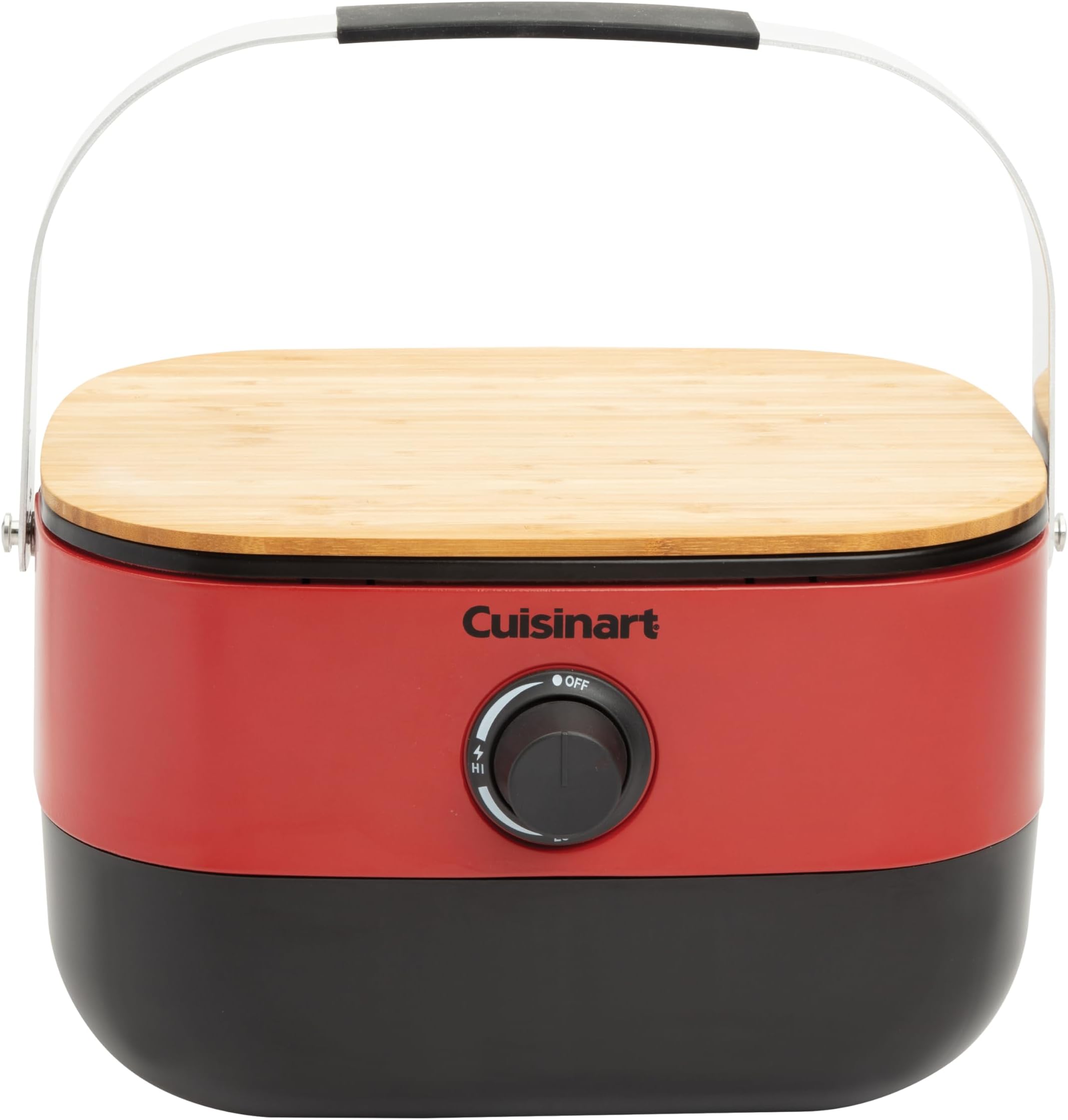
The Cuisinart Venture takes a genuinely different design approach, prioritizing aesthetics and self-contained convenience alongside cooking performance. The wooden lid doubles as a cutting board and serving surface — a feature that sounds like a gimmick until you’re prepping ingredients and suddenly have a clean surface without unpacking extra gear.
The 154 sq in porcelain-enameled cast iron grate delivers solid heat retention and produces consistent sear marks for a single-burner unit. The 9,000 BTU stainless steel burner with twist-start ignition heats up quickly and lights reliably, even in breezy conditions. The integrated propane management stores your 1 lb tank internally when packing up, and a flip-out rack holds it stable during cooking.
The rubber-grip aluminum carry handle makes it comfortable to transport at 20 lbs. I found it ideal for outdoor entertaining where presentation matters — it draws compliments and starts conversations at every cookout where I’ve used it. The lack of a traditional grill lid means indirect cooking isn’t an option, but for direct-heat grilling of steaks, burgers, and vegetables it performs admirably. Pair it with quality BBQ accessories for the complete outdoor cooking experience.
Highlights
- Wooden lid doubles as a functional cutting board and serving surface, eliminating the need to pack separate prep gear
- Integrated base stores the 1 lb propane tank internally when packing up — no loose parts or dangling hoses
- Flip-out propane rack keeps the tank upright and stable during cooking, with built-in clips to store the hose neatly
- 9,000 BTU stainless steel burner heats up fast and stays lit reliably even in breezy outdoor conditions
- Porcelain-enameled cast iron grate provides superior heat retention and consistent sear marks for a compact unit
- Self-contained stack-and-go design with rubber-grip handle makes it genuinely easy to carry to any outdoor setting
Specifications
- Cooking area: 154 sq in
- BTU: 9,000 (1 stainless steel burner)
- Weight: 20 lbs
- Fuel: 1 lb LP cylinder (stored internally)
- Lid: Wooden cutting board / serving surface
Customer Reviews
- “Just get it. Packs down to picnic basket size with room for the propane tank inside. I made teriyaki chicken for 6 people on the beach with no problem. The cutting board, grill top, and drip tray all go in the dishwasher.”
- “Cast iron surface that heats evenly, sturdy legs, piezo igniter, integrated tank storage, and a wooden cutting board — it has everything I want in a portable grill. Don’t think twice.”
- “I like the overall design. It heats up super quickly and it lights and stays lit in windy conditions. It is a little bit heavy to carry. But ease in storing it given the design makes it worth the extra weight. For open grilling, it’s good.”
Cuisinart Chef’s Style CGG-306 Tabletop Propane Grill – Best 2-Burner Tabletop
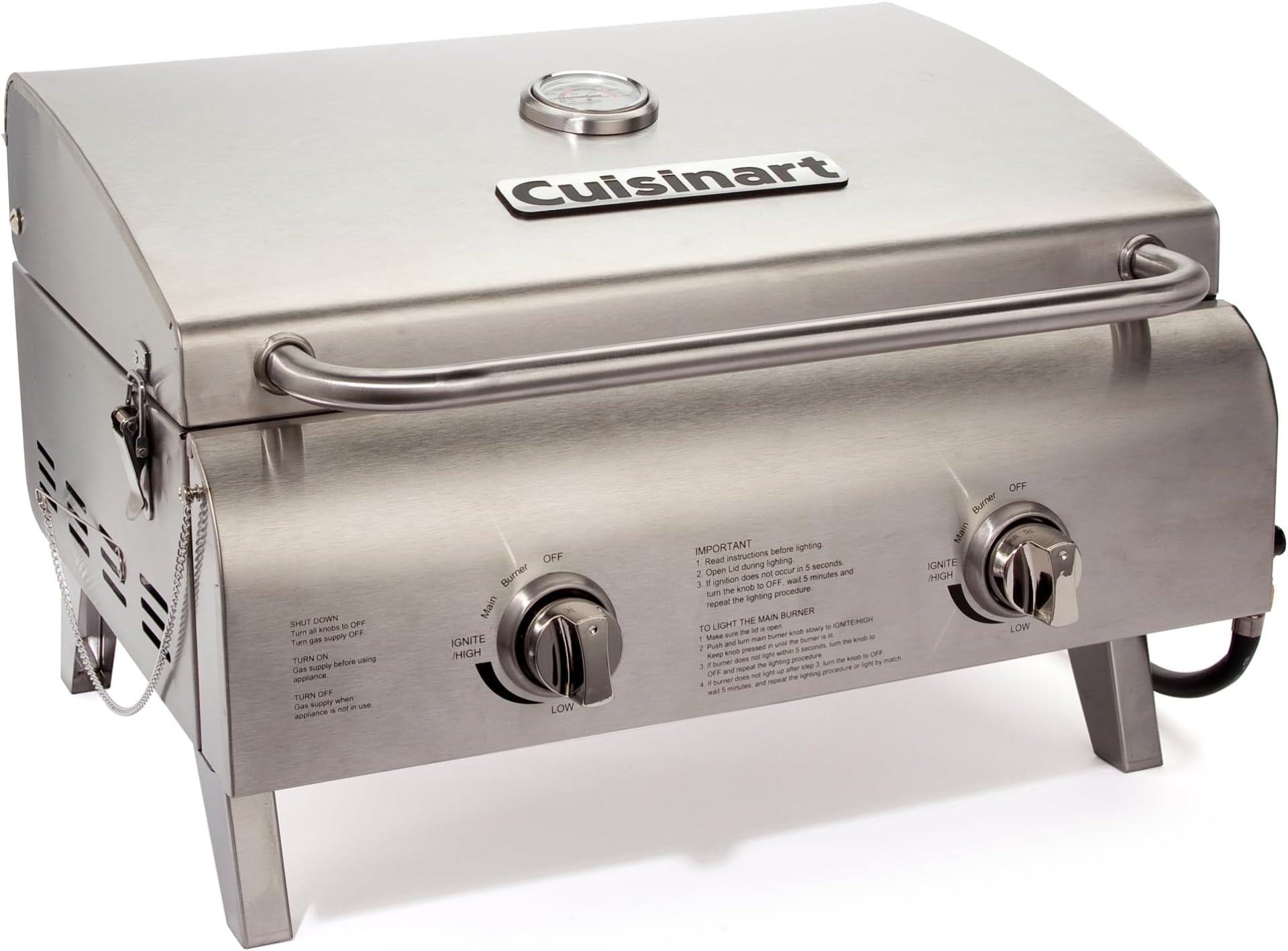
The Cuisinart CGG-306 earns the best 2-burner tabletop designation by delivering genuine dual-zone cooking control in a compact, all-stainless steel package that holds up season after season. Two independently controlled 10,000 BTU stainless steel burners give you 20,000 BTU total across 275 sq in — the highest BTU-per-sq-in ratio on this list at approximately 73 BTU per square inch.
That translates to fast preheat, excellent searing capability, and the ability to run one side hot for proteins while the other side holds lower heat for vegetables or warming finished food. The all-stainless steel construction — grates, burners, body — is the standout durability feature. Unlike grills that combine stainless exteriors with cheaper interior components, the CGG-306 uses stainless throughout, resisting rust and corrosion even with less-than-perfect storage.
The built-in lid thermometer monitors cooking temperature accurately, and the folding legs with locking lid make transport and storage straightforward at 22 lbs. Setup requires no tools and takes under 10 minutes. For apartment dwellers who want dual-zone capability without the footprint or weight of a freestanding grill, this is the best value option on the market. For more budget-conscious options, see our budget-friendly gas grills guide.
Highlights
- Two independently controlled burners create true dual-zone cooking — sear proteins on one side while holding vegetables at lower heat on the other
- All-stainless steel construction throughout (grates, burners, and body) resists rust and corrosion even with imperfect storage
- Highest BTU-per-sq-in ratio on this list at ~73 BTU/sq in, delivering fast preheat and serious searing capability
- Locking lid and folding legs make transport and compact storage straightforward at just 22 lbs
- Tool-free setup in under 10 minutes makes it practical for apartment patios, camping trips, and tailgates alike
- Compatible with standard 20 lb tanks via adapter, making it equally suitable as a permanent patio grill
Specifications
- Cooking area: 275 sq in
- BTU: 20,000 total (2 x 10,000 BTU burners)
- Weight: 22 lbs
- Fuel: 16.4 oz LP cylinder (full-size tank compatible with adapter)
- Construction: All stainless steel
Customer Reviews
- “Compact size is perfect for a small yard and easy enough to take camping or to the beach. We’re a family of two and meal prep a full week of food on this without any issues.”
- “Stainless steel build feels super durable, and the two independent burners give excellent control — steaks on high, veggies on low at the same time. No-tools setup and reliable ignition every time.”
- “Solid construction, heavy grate, and even heat with no dead spots. Snaps closed with a handle, making it genuinely easy to take on trips. Gets compliments every time I bring it out.”
Safety Guidelines for Small Gas Grills
Safe operation matters with any propane equipment. These are the practices I follow and recommend:
- Ventilation is non-negotiable: Always operate propane grills outdoors with adequate airflow. Never use any propane appliance indoors, in a garage, or under a canopy without sufficient ventilation. Propane combustion produces carbon monoxide, which is lethal in enclosed spaces.
- Leak test at the start of every season: Apply soapy water to all connections and hose fittings. Bubbles indicate a leak that must be resolved before lighting. Check connections at the start of each season and whenever you connect a new tank.
- Maintain safe clearances: Position your grill at least 10 feet from your home, deck railings, and any combustible material. Apartment fires frequently start from improperly positioned outdoor cooking equipment.
- Follow correct lighting procedure: Open the lid before igniting to prevent gas buildup. If the burner doesn’t light within 5 seconds, shut off the gas, wait 5 minutes for dispersal, then try again. Never lean over the cooking surface when lighting.
- Apartment and balcony regulations: Many apartment complexes and municipalities restrict or prohibit open-flame cooking on balconies. Check your lease and local fire code before purchasing any propane grill for balcony use. In restricted situations, electric tabletop grills may be the only compliant option.
- Propane storage: Store cylinders upright, outdoors, and away from heat sources. Never store tanks inside your home, vehicle, or garage. Inspect for rust and damage before each use.
Advanced Tips for Compact Grill Cooking
After years of testing small gas grills, these techniques consistently improve results on limited cooking surfaces:
- Use hot spots strategically: Single-burner units naturally have a hotter center zone. Use this for initial searing, then move proteins toward the edges to finish at lower heat. This creates effective two-zone cooking without a second burner.
- Indirect cooking on small surfaces: On dual-burner models, turn off one burner and place food over the unlit side with the lid closed. This produces results close to what a full-size grill achieves with indirect heat. On the Coleman RoadTrip 285, three-zone control makes this especially effective.
- Batch cooking for larger groups: Cook proteins that benefit from resting time first, then use that rest window to cook sides. This approach lets a 285 sq in grill feed groups of six or more over the course of a cookout.
- Wind management: Compact grills are more susceptible to wind-related temperature drops than full-size cabinet grills. Position your setup perpendicular to prevailing wind direction and consider a portable windscreen for exposed locations. The Weber Q-series enclosed design handles wind notably better than open tabletop grills.
- Smoke flavor on propane: Place a handful of soaked wood chips in a foil pouch, poke a few holes, and set it directly on the burner. Close the lid and allow smoke to build before adding food. This technique works on any of the covered grills listed above. See our Smokenator guide for additional smoke-infusion techniques.
Frequently Asked Questions
What size small gas grill do I need for a small patio?
For a small patio serving 2–4 people, look for a cooking surface between 200–300 square inches. That’s enough for 6–8 burgers simultaneously. If you’re cooking for one or two people regularly, 150–200 sq in is sufficient and keeps the footprint minimal. Always measure your available space with clearance included — you need at least 2 feet of clearance on all sides from combustible surfaces for safe operation.
Are compact propane grills worth the investment?
Yes, for anyone with limited outdoor space or who values portability, a compact propane grill is an excellent investment. The best models in the mid-range deliver cooking performance that rivals full-size grills, with faster preheat, lower fuel consumption, and significantly less cleanup time.
How long do small gas grills typically last?
With proper care and off-season storage, a quality compact propane grill lasts 5–15 years. Stainless steel burners are the key durability indicator — they last 5–10 years versus 2–3 seasons for aluminized steel. Weber grills in particular are known for decade-plus longevity thanks to strong parts availability. Regular cleaning, proper grate seasoning, and using a fitted cover significantly extend lifespan.
Can small propane grills connect to a large tank?
Many compact grills designed for 1 lb LP cylinders can also connect to standard 20 lb propane tanks using an adapter hose. The Weber Q 2800N+ uses a standard 20 lb propane tank, while the Cuisinart CGG-306 supports larger tanks through an optional adapter. This is a worthwhile upgrade for home patio use where portability isn’t required and you want to avoid frequent small cylinder purchases.
How do I clean a compact propane grill?
Proper grill cleaning follows a simple routine:
- After each use: Preheat on high for 10–15 minutes to burn off residue, then brush grates with a grill brush (avoid wire bristles that can shed).
- After cooling: Remove and empty the grease tray, wipe the exterior with warm soapy water.
- Monthly: Inspect burner ports for blockages and clear with a toothpick or pipe cleaner.
- At season’s end: Deep clean the firebox, re-season cast iron grates, and store with a fitted cover.
Are small gas grills safe for apartment balconies?
It depends on your jurisdiction and building rules. Many municipalities prohibit open-flame cooking on balconies above a certain floor. Some apartment leases ban all propane grills regardless of local code. Always check your lease agreement and local fire codes before purchasing. Infrared electric tabletop grills are the compliant option in many restricted situations. See our infrared grill guide for alternatives.
What’s the difference between a portable gas grill and a small patio gas grill?
Portable gas grills are designed for frequent transport — they prioritize low weight, fold-flat legs, locking lids, and carry handles. Small patio gas grills prioritize cooking capability and stability over maximum portability. Many grills on this list serve both purposes well, but the Weber Q 2800N+ and Cuisinart VersaStand lean toward portable use, while the Cuisinart CGG-306 and Coleman RoadTrip 285 are better suited for semi-permanent patio setups.
How often should I replace the cooking grates on a small gas grill?
With proper care, cooking grates last 5–15 years. Replace them when you see significant rust, warping, or flaking porcelain coating that can’t be resolved with re-seasoning. Cast iron grates last longest when you maintain proper seasoning and avoid thermal shock — never spray cold water on hot grates. For more detail, see our grill grates guide.
What’s the best small propane grill for camping?
For camping specifically, the Cuisinart VersaStand and Weber Q 2800N+ are the top choices. The VersaStand is lighter and accepts compact cylinders widely available at outdoor retailers. The Weber Q 2800N+ is larger but delivers stronger performance, a wider temperature range, and better heat distribution for full meals. If weight is the primary concern, the VersaStand wins. If cooking quality matters more, the Weber is worth the extra size.
Conclusion
A compact propane grill is one of the best investments you can make if outdoor space is limited. The five models above cover every use case — from the ultra-lightweight Cuisinart VersaStand for solo camping trips, to the dual-zone CGG-306 for apartment patio cooking, to the versatile Coleman RoadTrip 285 for entertaining.
In my testing, the most important differentiators are heat distribution consistency, ignition reliability across weather conditions, and build quality that holds up through repeated heating and cooling cycles. Don’t get caught up chasing maximum BTU numbers — a well-engineered 10,000 BTU unit consistently outperforms a poorly designed 20,000 BTU competitor. Focus on cooking area per burner, construction materials, and ignition system quality. All five picks above deliver on those fronts.
For more outdoor cooking options, explore our guides to mid-range propane grills, infrared cooking options, and premium gas grills. And if you’re building your grilling skills, our grilled corn guide and beer can chicken recipe are great starting points for any compact grill.