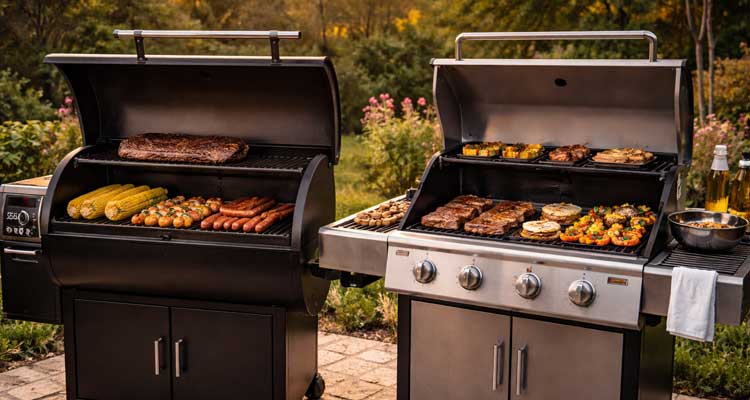
 You’re standing in the backyard section of a home improvement store, looking at two grills. One runs on propane and has a row of control knobs. The other has a hopper full of wood pellets and a digital display. After testing both types extensively and cooking on everything from entry-level Pit Boss models to premium Traegers and Weber gas grills, we’ve broken down exactly how these two grill types compare – so you can make the right call for your backyard.
Helpful gear for this cook:
- Temperature control: Grill Armor extra-long heat-resistant gloves protects your hands around hot grates, pans, and smoker parts.
- Handling: ThermoMaven bristle-free grill brush cleans grates without leaving wire bristles behind.
- Prep: AMMZO digital meat thermometer checks doneness without guessing.
Pellet Grill vs Gas Grill: The Short Answer
| Pellet Grill | Gas Grill | |
|---|---|---|
| Best for | Smoking, BBQ, long cooks | Quick grilling, searing, weeknights |
| Flavor | Rich wood smoke | Clean, mild char |
| Startup time | 10-15 minutes | 2-5 minutes |
| Upfront cost | $350-$2,500 | $200-$1,500 |
| Annual fuel cost | ~$150-$250 | ~$50-$80 |
How Each Grill Works
Understanding the mechanics makes the differences between pellet grills and gas grills immediately obvious – and it explains why each one excels at different tasks.
How a Pellet Grill Works
A pellet grill is essentially a wood-fired convection oven. Wood pellets sit in a hopper on the side of the unit. An auger – a rotating screw – feeds pellets at a controlled rate into a fire pot, where they ignite and burn. A fan circulates the hot, smoky air across the cooking chamber, cooking food evenly from all sides. The temperature is managed digitally by a PID controller (or basic on/off controller on budget models). Set your target temperature, and the controller adjusts how fast the auger feeds pellets. Most pellet grills hold temperature within ±10-15°F of your set point, anywhere from 180°F up to 500°F. WiFi-enabled models from brands like Traeger, Recteq, and Pit Boss allow you to monitor and adjust temperature from your phone.
How a Gas Grill Works
A gas grill burns propane or natural gas through burner tubes positioned underneath the cooking grates. Turn a knob, hold the ignition, and you have live flame within seconds – no startup period, no preheating required. Most gas grills feature multiple independently controlled burners, letting you create direct-heat and indirect-heat zones across the cooking surface. Gas grills can reach 500-600°F on standard burners, and dedicated sear stations or infrared burners on higher-end Weber and Napoleon models push even hotter. They cool down quickly too, which is both a feature (for fast cleanup) and a limitation (poor heat retention for long smokes).
Flavor: Wood Smoke vs. Clean Heat
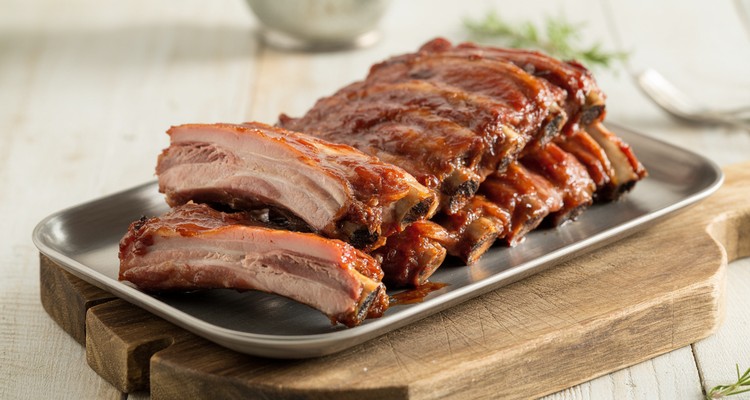
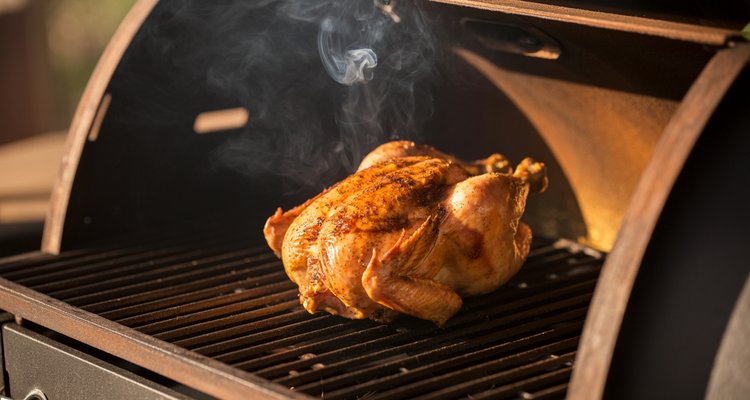
This is the category where pellet grills pull away decisively. Propane is odorless and tasteless – it produces heat, not flavor. Food cooked on a gas grill picks up a light char from the grates and any drippings that hit the burners, but there’s no smoke flavor in the traditional BBQ sense. Pellet grills burn real wood, and that combustion produces aromatic smoke compounds that penetrate the meat. The wood species you choose directly shapes the flavor of your food. Hickory delivers bold, bacon-like smokiness that works beautifully on ribs and brisket. Apple and cherry add subtle sweetness and a gorgeous mahogany color to poultry and pork. Mesquite burns hot and intense, suited for quick cooks like steaks and fajitas. Pecan sits in the middle – nutty and mild, versatile enough for almost anything. For smoked brisket, pulled pork, ribs, or whole turkey, a pellet grill isn’t just better than a gas grill – it’s in a different category entirely. For a Tuesday night burger or grilled chicken breast, the gap narrows considerably.
Temperature Range and Control
Pellet grills typically operate between 180°F and 500°F. That lower bound is what makes them so good for smoking – a 225°F hold for 10-12 hours produces the kind of brisket and pulled pork that gas grills simply cannot replicate. The digital controller handles everything automatically, adjusting pellet feed rate every few seconds to maintain your target. Gas grills operate from roughly 300°F up to 600°F or higher on infrared sear stations. That upper range is where gas grills have a real advantage – nothing produces a steak crust as efficiently as a 600°F direct flame. The lower end, however, is difficult to dial in. Gas grills struggle to hold temperatures below 225°F without going out entirely, making true low-and-slow smoking nearly impossible without modifications.
Cost – Upfront and Running
Purchase Price
Gas grills are generally less expensive at entry and mid-range price points. A solid 3-burner gas grill from Weber Spirit or Napoleon Rogue costs $400-$700. Entry-level pellet grills from Pit Boss and Z Grills start around $350, but the performance gap between a $350 pellet grill and a $700 one is significant. Quality pellet grills from Traeger, Recteq, and Yoder run $800-$2,500. Our best pellet grills guide breaks down the top models across every price point.
Fuel Costs
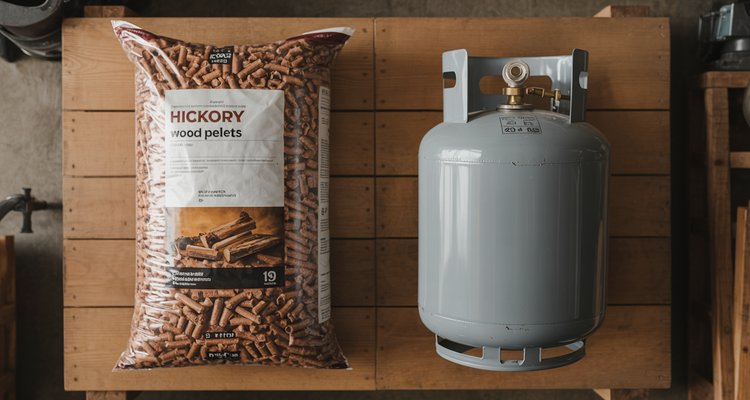
| Fuel Factor | Pellet Grill | Gas Grill |
|---|---|---|
| Fuel type | Wood pellets | Propane or natural gas |
| Cost per unit | $5-$8 per 20 lb bag | $3-$5 per propane tank |
| Burn rate (low & slow) | ~1 lb/hr at 225°F | ~0.5 lb/hr |
| Burn rate (grilling) | ~2 lb/hr at 375°F+ | ~1 lb/hr |
| Annual cost (avg. user) | $150-$250 | $50-$80 |
| Fuel availability | Hardware stores, online | Gas stations, hardware stores |
How Long Do Pellets Last?
The burn rate depends on temperature. At 225°F (typical brisket or ribs temp), a pellet grill burns approximately one pound of pellets per hour. A 20-pound bag lasts about 20 hours – plenty for most weekend cooks. At higher temps, consumption increases:
- 225°F (low & slow): ~1 lb/hr → 20 lb bag lasts ~20 hours
- 325°F (roasting): ~1.5 lb/hr → 20 lb bag lasts ~13 hours
- 400°F+ (grilling): ~2 lb/hr → 20 lb bag lasts ~10 hours
At $5-$8 per bag, a 12-hour brisket cook costs roughly $4-$6 in pellets. A comparable gas cook uses less than half a propane tank – about $2-$3. Gas wins on pure fuel economy, but the difference is modest for most backyard cooks.
Ease of Use and Convenience
Startup and Preheat Time
Gas grills win this category by a wide margin. Turn the knob, press ignition, wait two minutes – you’re cooking. That instant-on experience is hard to beat for weeknight meals when you want dinner on the table in 30 minutes. Pellet grills take 10-15 minutes to reach cooking temperature. The fire pot ignites the first batch of pellets, and the fan cycles to raise the chamber temperature. Most modern pellet grills have a rapid startup mode, but they still can’t match the immediacy of gas.
Set-and-Forget vs. Active Grilling
Once up to temperature, pellet grills flip the convenience equation. You set your target temperature, load the food, and walk away. The digital controller maintains temperature automatically for hours – even overnight for an 8-hour pork shoulder cook. Many models with WiFi apps let you monitor internal meat temperature from inside the house. Gas grills require more active attention, particularly for longer cooks. Fat drippings land on burners and cause flare-ups. Multiple burner zones need periodic adjustment to maintain indirect heat. For a 30-minute chicken cook, this is no issue. For a 4-hour rib cook, the pellet grill’s hands-off nature is a genuine advantage.
Learning Curve
Gas grills have almost no learning curve – if you’ve used a kitchen stove, you understand the basic mechanics. Pellet grills are slightly more involved: you need to manage pellet levels to avoid running empty mid-cook, keep pellets dry to prevent auger jams, and understand how different temperature settings affect smoke output. None of this is difficult, but there’s more to learn.
Searing Capability
For searing steaks, burgers, and chops, gas grills have a real advantage. Direct flame at 500-600°F produces rapid Maillard browning – the chemical reaction that creates a dark, flavorful crust. Gas grill grates reach temperature fast and stay there consistently, making it easy to control your sear. Pellet grills have historically struggled with searing. Most top out at 500°F, and that heat is indirect (convection airflow rather than direct flame). The result is a lighter sear compared to what you’d get over direct gas flame. This is improving – newer models from Recteq, Weber Searwood, and Traeger Timberline now include direct flame access ports that significantly close the gap. For those without direct-flame pellet grills, the reverse sear method (described in the temperature section above) produces excellent results on any pellet grill. It just requires a cast-iron skillet or secondary searing station.
Maintenance and Cleaning
| Task | Pellet Grill | Gas Grill |
|---|---|---|
| After each cook | Brush grates | Brush grates, burn off |
| Every 2-3 cooks | Empty ash from fire pot | Check grease trap |
| Monthly | Vacuum ash, clean fire pot | Clean burner tubes |
| Seasonally | Deep clean, check auger, season grates | Deep clean, check gas connections |
| Special requirement | Keep pellets dry (moisture jams auger) | Check propane level before cooking |
| Estimated time per year | 3-5 hours | 1-2 hours |
Gas grills are the low-maintenance option. After cooking, crank the burners high for a few minutes to incinerate any residue, then brush the grates. The whole process takes five minutes. Pellet grills generate ash every time you cook – the fire pot needs emptying every two to three cooks or it restricts airflow and can cause temperature problems. This adds 10-15 minutes of cleanup to each session. Pellets must also be stored in an airtight container; moisture causes them to swell and can jam the auger system.
Versatility – What Can Each Grill Do?
A gas grill is primarily a high-heat tool. It grills, sears, roasts with indirect heat, and (with rotisserie attachments) spins. Some gas grills include side burners for sauces and sides. What they cannot do meaningfully is smoke – the heat retention is too poor and there’s no combustion material to produce smoke compounds. Even with a smoker box full of wood chips, you’ll get a fraction of the smoke flavor that a dedicated pellet grill delivers. A pellet grill is genuinely multi-functional. It grills, smokes, roasts, bakes, and even braises. Many pellet grill owners discover they can bake bread, smoke desserts, and cook entire Thanksgiving meals on their pellet grill. It functions as a full outdoor oven, which makes it far more versatile than a gas grill for serious outdoor cooks. For dedicated smoking with maximum capacity, vertical pellet smokers offer even more specialized performance.
Full Comparison: Pellet Grill vs Gas Grill
| Feature | Pellet Grill | Gas Grill |
|---|---|---|
| Flavor | Rich wood smoke | Clean, mild char |
| Temperature range | 180-500°F | 300-700°F+ |
| Temperature control | Digital, automatic (±10-15°F) | Manual knobs |
| Startup time | 10-15 minutes | 2-5 minutes |
| Searing ability | Limited (improving) | Excellent |
| Smoking ability | Excellent | Poor |
| Annual fuel cost | $150-$250 | $50-$80 |
| Upfront cost | $350-$2,500 | $200-$1,500 |
| Maintenance | Moderate (ash removal) | Low |
| Versatility | High (grill + smoke + bake) | Medium (grill + roast) |
Which Grill Is Right for You?
Choose a Pellet Grill If…
- You love smoked brisket, ribs, pulled pork, or whole poultry and want authentic wood-fire flavor
- You prefer hands-off cooking – set the temp and walk away for hours without babysitting
- You want one outdoor appliance that can grill, smoke, roast, and bake
- You cook large cuts (whole brisket, pork shoulder, spatchcocked turkey) regularly
- You’re willing to do more maintenance and store pellets properly
Choose a Gas Grill If…
- You primarily cook burgers, steaks, chicken breasts, and vegetables on weeknights
- You want to go from cold to cooking in under five minutes
- You value low maintenance and simple cleanup after every cook
- Your budget favors a lower upfront cost and cheaper running costs
- A powerful, direct-heat sear is important to how you cook most often
Can You Own Both?
Many serious outdoor cooks end up with both – and it’s not as expensive as it sounds. An entry-level pellet grill from Pit Boss or Z Grills costs around $350. A solid two-burner gas grill from Weber Spirit runs roughly $250-$350. For a combined investment of $600-$700, you get the weeknight speed of gas and the weekend BBQ capability of a pellet grill. That’s not a rare setup – it’s how most dedicated backyard cooks eventually land.
Frequently Asked Questions
Can I use a pellet grill like a regular grill?
Yes. At 375-425°F, a pellet grill performs like a traditional grill for burgers, chicken thighs, vegetables, and fish. The main differences are a 10-15 minute startup time vs. the near-instant startup of gas, and slightly less pronounced sear marks due to indirect airflow heat rather than direct flame. For most everyday grilling, the difference is minor.
Are steaks good on a pellet grill?
Yes – particularly using the reverse sear method. Smoke the steak at 225°F until it reaches 110-115°F internal temperature, then finish on a screaming-hot cast-iron skillet or grill pan for a deep crust. Models with direct flame access (Recteq, Weber Searwood, Traeger Timberline) can sear directly on the grill. Traditional high-heat searing is harder on a standard pellet grill, but the reverse sear produces exceptional results.
What are the main disadvantages of a pellet grill?
The biggest drawbacks are higher upfront and running costs, a longer startup time (10-15 minutes), moderate maintenance requirements (ash removal after each cook), pellet storage requirements (must be kept dry), and dependence on electronics – if the controller fails mid-cook, you have a problem. They also don’t sear as aggressively as a gas grill without special attachments.
How long does a 20 lb bag of pellets last?
It depends on cooking temperature. At 225°F for low-and-slow BBQ, a pellet grill burns approximately one pound of pellets per hour, so a 20-pound bag lasts around 20 hours. At 325°F it lasts roughly 13 hours, and at 400°F+ for grilling it lasts about 10 hours. At $5-$8 per bag, pellet costs are reasonable even for heavy users.
Which is easier to clean – pellet or gas grill?
Gas grills are easier to clean. After cooking, run the burners high for a few minutes to burn off residue, brush the grates, and you’re done. Pellet grills require ash removal from the fire pot every two to three cooks, plus the occasional vacuum of the cooking chamber interior. Both need periodic deep cleans, but gas requires significantly less routine cleanup time.
Can a pellet grill replace my gas grill entirely?
For most outdoor cooks, yes – around 80% of the time. Pellet grills handle everyday grilling, roasting, and smoking well. The gaps are startup speed (gas wins by 10 minutes) and extreme high-heat searing (gas wins unless you have a direct-flame pellet grill or use cast iron). If you primarily cook low-and-slow BBQ, a pellet grill is a full replacement. If you sear steaks every week and value speed, you’ll miss having gas.
Is a pellet grill worth the extra cost?
If you cook smoked BBQ regularly, absolutely yes. The flavor difference between real wood-smoked ribs and gas-grilled ribs is significant enough to justify the premium. Even using the hot and fast brisket method, you get smoke flavor impossible to achieve on gas. If you grill burgers and chicken a few times a week and rarely smoke, a gas grill delivers better value. The pellet grill earns its cost when you use the smoking capability – without it, you’re paying extra for features you don’t need.
How much do wood pellets cost per year?
For a typical backyard cook who uses the grill once or twice a week, expect to spend $100-$200 per year on pellets. Frequent users who smoke large cuts on weekends may spend $250-$400 annually. Compare this to propane for a gas grill, which typically runs $50-$80 per year for average use. Pellets cost roughly 2-3x more annually than propane for the same cooking frequency.
What are the most common pellet grill mistakes?
The four most common mistakes are: letting pellets get wet (swollen pellets jam the auger and cause shutdown), not emptying the ash pot regularly (buildup restricts airflow and leads to temperature swings), running out of pellets mid-cook (always check your hopper before a long cook), and opening the lid too frequently (each opening releases smoke and drops temperature, extending cook time and reducing smoke penetration).
Which grill is better for beginners?
Both are beginner-friendly, but for different reasons. Gas grills are simpler – turn a knob, press a button, cook. Pellet grills require learning about pellet management, smoke production, and ash cleanup, but the digital temperature controller actually makes them easier to cook on than charcoal. If you want to get into smoked BBQ without the steep learning curve of charcoal or offset smokers, a pellet grill is an excellent starting point.
Final Thoughts
There’s no universal answer to the pellet grill vs gas grill debate – there’s only the right answer for how you cook. If your weekends involve whole briskets, long rib sessions, and smoked turkey, a pellet grill is a game-changer that a gas grill simply can’t replicate. If your weeknights involve burgers and chicken breasts that need to be on the table in 30 minutes, a gas grill’s instant-on convenience is hard to beat. The good news is that neither choice is wrong. Both produce excellent food. Both have loyal followings for good reasons. And if your outdoor cooking grows into a real passion, you’ll likely end up with one of each – which, as many backyard cooks discover, is the most satisfying setup of all.